Welcome to my blog! I post about the world, writing, science, miscellany, books, movies, politics, and a wide range of other subjects. Take a look around and see if something catches your eye!
Mineralogy is what it sounds like: The study of minerals, such as their physical properties, distribution, and identification. A mineral is a naturally occurring crystal of a chemical compound or an element that has a set (unchanging and predictable) chemical composition.
Last August, mineralogy expanded to a new planet--Mars. The Chemistry and Mineralogy instrument, also known as CheMin, onboard the Curiosity Rover, has already detected several different minerals including jarosite, a mineral formed when water evaporates. CheMin works by drilling a hole in a rock in question, collecting the dust produced by the drilling, and firing a beam of X-rays through the dust. X-rays cause specific atoms to either absorb or emit light--these patterns indicate exactly which elements are present in the sample.
Tonight (or tomorrow morning, depending on how you look at it and where you are geographically) Curiosity will be landing on Mars. Its payload has ten times the mass of other rovers sent to the planet, and the goal for the rover is to check if life could or did exist there.
Curiosity, unlike other craft sent up, is capable of testing rock and dirt samples onboard itself; the plutonium power supply is predicted to last for 687 Earth days/one Mars year. Scientific instruments carried by the rover include spectrometers, the Mars Hand Lens Imager (designed to take highly magnified images), the Mast Camera (for taking pictures of the landscape), and the Radiation Assessment Detector.
The news, as you might expect, is causing quite the buzz. The only problem? EDL, or "Entry, Descent, and Landing". It takes several stages for the rover to descend from the atmosphere to the ground and for seven minutes there will be nothing from Curiosity. It may even be longer than that until we on Earth know if it successfully landed (due to the position of two satellites around Mars and the rover's position relative to Earth); if it doesn't reach the planet all in one piece, there will never be a signal at all.
This span of time between entry and landing is (rather aptly) called the 7 Minutes of Terror.
In the words of NASA scientists:
Or if you'd rather not watch a video, this graphic sums up the process:
Detailed animation of what the landing should look like:
If you'd like to find out when the rover will be landing in YOUR timezone, go HERE. You can bet I'll be up in the middle of the night checking the feeds; and speaking of feeds, BoingBoing has a handy list of resources, and I believe that SciShow, MarsCuriosity, and NASA TV will be streaming live about the landing.
Today I have the honor of presenting a guest post by Stephen Tremp, author of Breakthrough and Opening, about all the cool stuff NASA has going on.
Take it away, Stephen!
**********
Thank you Golden Eagle for hosting me on my Grand OPENING Blog Tour today! We are going for an aerial perspective that is relevant and exciting!
So what’s the latest and greatest regarding NASA? And why should I care, you ask? Hasn't the shuttling of the Space Shuttle Program and cutbacks in funding and lack of vision from our political leaders made this once awesome organization boring and irrelevant? Well, please allow me dispel these thoughts and take you on a tour of the NASA Web site.
NASA: The National Aeronautics and Space Administration is the agency of the United States that is responsible for the nation's civilian space program and for aeronautics and aerospace research. Since February 2006, NASA's mission statement has been to "pioneer the future in space exploration, scientific discovery, and aeronautics research.”
You can check out the latest and greatest in news, missions, multimedia, apps, and other ways to connect with NASA. You can even plan a visit to some of their eighteen facilities across the United States.
NASA For Students: Have kids? Are you a school teacher, home schooler, or know someone who is? Then the NASA for Educators, the NASA for Students, and the NASA Kids Club and are worth a navigating and Bookmark or save in your Favorites.
NASA for Students is broken up into grade groups of: K-4 5-8 9-12 Higher Education
Each group has age appropriate links. Example, NASA is sponsoring the 2012 NASA Space Settlement Design Program for 6th through 12 graders and can join as individuals, groups, or entire classrooms.
Design a space settlement! Space settlements are permanent communities in orbit, as opposed to being on the moon or other planets. Designing a space settlement involves physics, mathematics, space science, environmental science and many other disciplines. This contest is for 11-18-year-old students from anywhere in the world. Individuals or teams may enter. Grades 6-8, 9-10 and 11-12 are judged separately, except for the grand prize. Submissions must be received by March 15, 2012. Click the link for more details, contest prizes, and certificates.
And check out the Current Opportunities for Kids link. NASA also hosts youth ambassadors from around the globe for successful outreach programs. NASA’s Web site is a great site for kids to research homework and for author to research their novels.
What about classrooms and partnering with other classrooms around the globe?
Connect with NASA: Yep. There's an app for that. Check out the various apps and social networks NASA has such as Facebook and Twitter.
What's Next For NASA? NASA is conducting an unprecedented array of missions that will seek new knowledge and understanding of Earth, the solar system and the universe. NASA has observatories in Earth orbit and deep space, spacecraft visiting the moon and other planetary bodies, and robotic landers, rovers, and sample return missions. One example is designing and building the capabilities to send humans to explore the solar system and working toward a goal of landing humans on Mars.
NASA has a payback on our hard-earned tax dollars, providing great paying jobs, supporting entire communities, and opening doors for incredible future opportunities such as planet colonization and mining asteroids (more on this in a future post).
Thanks again Golden Eagle for hosting me today. I hope this inspires a lot of people to do great things with their lives!
Stephen Tremp, author of the BREAKTHROUGH series, has a B.A. in information systems and an MBA degree in global management. Stephen has a background in information systems, management, and finance and draws from this varied and complex experiential knowledge to write one-of-a-kind thrillers.
His novels are enhanced by current events at the European Organization for Nuclear Research (CERN) and other scientific research facilities around the world. These potential advances have the ability to change the way we perceive our universe and our place in it!
Spirit made a successful landing on January 4th, 2004, and Opportunity landed January 25th. So far, Opportunity has been functioning 25 times longer than originally planned. It is currently heading for the Endeavor crater.
Spirit on the other hand stopped communicating with Earth March 22nd 2010, although NASA is now trying other ways of communication in hopes the rover will wake from hibernation as its batteries charge from the Martian summer.
Both rovers discovered evidence that could indicate water used to be on Mars. Spirit found crystallized minerals in magma, possibly dissolved by water, along with a high concentration of salt in the soil. Opportunity found bedrock formations that form because of a current, along with hydroxide ions in jarosite, which could mean the mineral formed in the presence of water.
Hopefully, Spirit will communicate again with Earth and begin exploring Mars again. But even if it doesn't--it went far beyond its expected time--the rover made some important discoveries, as did its twin.
Stars form when gas, dust, and other materials out in space begin to gather together, forming larger and denser masses, which collect until there are huge clumps of dust and gas. The clumps are called protostars, and as gravity acts on the material, compressing it further, it heats up to over 10,000,000 degrees Kelvin. That is the point were hydrogen fusion can begin.
Hence, a star.
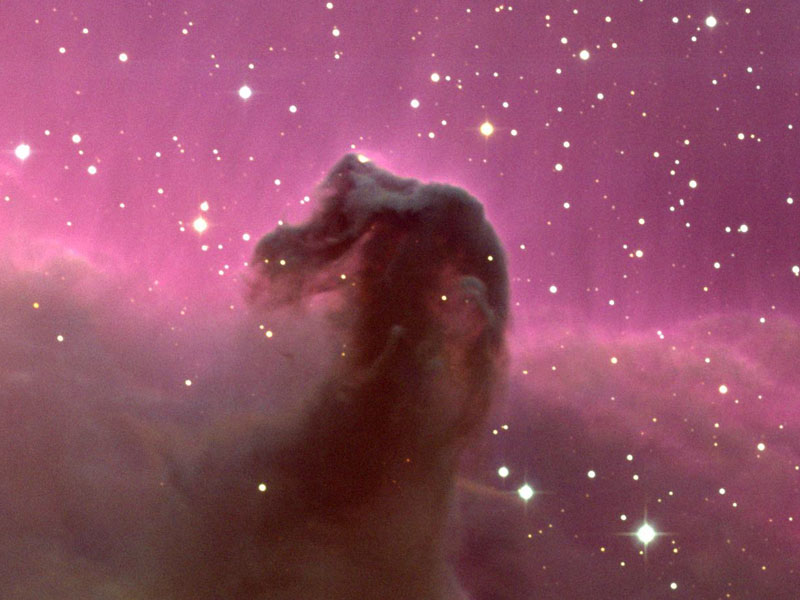
There are two sources of nebulae: exploding stars and material from the original formation of the universe.
There are also five major types. Emission, Reflection, Dark, Planetary, and Supernovae Remnants. (One thing I love about astrophysics--they keep the names in plain English.)