Showing posts with label Birds. Show all posts

17 April, 2013

A To Z Challenge: Ornithology And Observing Raptors

Ornithology is a branch of zoology that focuses on birds. According to the International Union for Conservation of Nature or IUCN, there are 9,865 species of birds within class Aves in the world. The earliest known bird, Archaeopteryx lithographica, existed 150 million years ago and had feathers, wings, and a reptilian face--birds are evolutionary descendants of reptiles.

Normally I'd give you a recent development in the field of ornithology, but instead I'll link to this live webcam of Bald Eagles in Washington, D.C. The juveniles--hatched last March--are the dark-colored ones in the nest, which is situated on the grounds of the Metropolitan Police Academy. There is also a highlights video on the right side of the page if you want to watch more exciting bits like the parents feeding the chicks.

**********

Sources:
http://www.thefreedictionary.com/ornithology
http://animals.about.com/od/birds/a/bird-facts.htm
http://birdwatchersdigest.com/youngbirders/coolbirdfacts/

**********

What are your favorite birds?


-----The Golden Eagle

26 April, 2011

A-Z Blogging Challenge: V Stands For: Vultures

Vultures, if you ask me, don't get enough respect.

(Ruppell's Griffon Vulture. SOURCE)

There are two kinds of vultures--Old World Vultures and New World Vultures, a total of 23 species. These two groups emerged through convergent evolution (when two separate populations acquire the same or similar traits), and are found on every continent except for Australia and Antarctica. Old World and New World aren't closely related, and they're only called vultures collectively because they occupy the same ecological niche.

(King Vulture. SOURCE)

Old World Vultures are part of the family Accipitridrae (which includes eagles, kites, buzzards, and hawks) and live in Africa, Asia, and Europe. These sorts of vultures find their food by sight only, and can see food up to 4 miles away.

New World Vultures, along with condors, live in the Americas. They belong to the family Cathartidae, which is part of the group of Accipitriformes. Several New World Vulture species have a good sense of smell and can scent their prey up to 1 mile.

(Egyptian Vulture. SOURCE)


The thing I don't get is why it's always the vulture who has the part of the bringer of death (and they don't actually hover over an animal that's about to die, though they will kill the sick and weak who would die anyway), symbolizes approaching doom, represents evil, shrieks and screams at the good guys, and all that other very charismatic stuff.

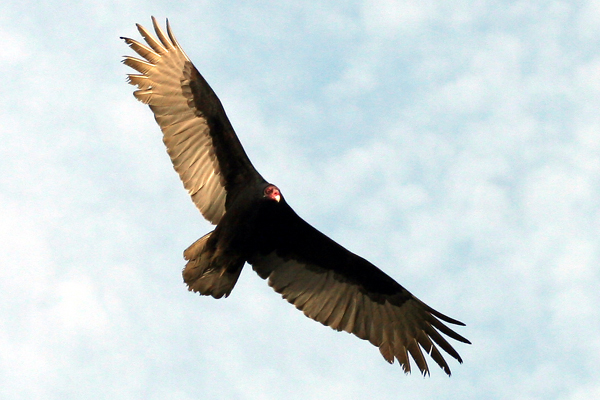
(Turkey Vulture. SOURCE)

So they eat dead things. Heck, they're not the only creatures in the animal kingdom who eat food that's been sitting around for a while. Scavengers actually help clean up the planet--without them, carcasses and bodies would simply hang around to rot and decay. But when it's eaten by something like a vulture, that problem is eliminated and all that's left are bone fragments and maybe a few scraps for other scavengers to pick up. Animals fed, body gone.

Isn't that a good thing?


*****

Sources:
http://en.wikipedia.org/wiki/Vulture
http://animal.discovery.com/birds/vulture/
http://ecolocalizer.com/2009/09/05/16-cool-facts-about-vultures-on-international-vulture-awareness-day/

And if you'd like to learn about International Vulture Awareness Day, go HERE.

*****

So, what do you think of vultures? Love or hate? Pests, or helpful cleanup crew?


-----The Golden Eagle

06 January, 2011

On This Last Day of Christmas: Twelfth Day, Birds, Fish, Video, The Replacement, And Writing

Technically it is the last day of Christmas, you know.

Not as many people celebrate it anymore, particularly not here in the USA, (*sigh* cheer in this country doesn't last too long) but, according to Wikipedia,  it is still celebrated throughout the world. Some do it n the 5th, yesterday, because (also according to Wikipedia) in medieval times the next day started at sundown, which meant the Night came before the Day. Now the day begins at midnight.

So it all depends on where you start.

*****

I am trying to be friends with Zemanta right now, because it really is a helpful widget.

It's just I was trying to write a post, and it just threw everything out the window. I moved an image around, it combined the text with the image's HTML, and then when I pressed CTRL+Z a few times to get rid of the image and the changes I had made, it all disappeared.

Whoo-hoo.

I suppose I could have been a little less enthusiastic about the CTRL+Z part and just cut out the HTML with the image, but I was trying to get it out fast, because it's later in the afternoon than I'd like and I want to get around to reading blogs!

I suppose I've been taught another lesson about haste makes waste--or, in this case, an obvious lack of anything at all. I won't be doing that again.

*****

Did you hear about the fish and birds that have been dying? Over 3,000 red-wing blackbirds, common grackles, and European starlings died in Arkansas, and 100,000 fish died 125 miles away. There has also been a major fish die-out in the Chesapeake Bay: 2,000,000 or so there.

It's sad. Not because these are signs the world is going to end--and this is perfect fuel for the that wacky Mayan theory--but because those were birds and fish and creatures are dying much too fast already.

*****

Speaking of animals:

http://www.pbs.org/wnet/nature/episodes/american-eagle/video-full-episode/4349/

(I would have embedded the video, but the code hates me today.)

*****

I finished The Replacement by Brenna Yovanoff on Monday, and since I don't want to write a separate post to review it, here a brief idea of what I thought it was like:

Plot: A little slow at the beginning, but it moved quickly enough to keep my interest I read it in a matter of hours. Characters: Loved Mackie Doyle, probably because I'm kind of solitary and an introvert myself. Setting: Creepy and a little disturbing, and I loved the way the human prejudice and general dislike of anything unknown was presented.

Overall: 4 out of 5. J'adore the cover.

*****

I had a good writing day today, and made up for yesterday's losses (I didn't write anything yesterday). I was also inspired by the music I was listening to--Beethoven's 9th Symphony. Usually it's not my favorite music, but it actually fits my book rather well.

Which leads me to ask: Are there any pieces of music that you've felt match your writing well?

*****

Well, there's my random and miscellaneous post for the week.

Hope you have a great Thursday!


-----The Golden Eagle

06 September, 2010

It Would Be A Stretch to Call Them Beautiful . . .

The California Condor is one of North America'...Image via Wikipedia

But it wouldn't be fair to call them totally ugly.

They may not be the prettiest creatures in the animal kingdom . . .

But they do us a service.

They may not look the nicest, or sound the greatest . . .

But they're definitely fascinating.

Their appearances are dark and moody . . .

But that doesn't mean they're cruel.

They may not eat what's considered delicate fare . . .

But at least someone's eating it.

I'm talking about . . .


The Californian Condor, or Gymnogyps Californianus.

The bird that was on the verge of extinction in 1987, with only 22 left, due to poaching, habitat destruction, and poisoning. The few that remained alive were captured and bred in the Sand Diego Wild Animal Park and the Los Angeles Zoo.

Until, in 1991, the numbers were up sufficiently to return the condors to the wild.

Currently, there are only 384 known, only 188 of those living out of captivity.

A real Condor moment...Image by law_keven via Flickr

Did you know that their heads change color depending on their emotions?

A Californian Condor in flight, photographed f...Image via Wikipedia


Did you know that their wingspan is almost 10 feet?


Did you know that they're mostly mistaken as small, far-off airplanes, as opposed to another species of bird?


Did you know that contrary to a lot of birds, the male is actually bigger than the female?


Did you know that they live in oakland savannas, coniferous forests, and scrubland?

I don't see why so many people don't like scavengers and carrion-eating birds such as the condor. Yes, they search for corpses.

But they don't actively fly over animals they think are going to die.

Yes, they stick their heads in those corpses.

But that's why they're bald.

Yes, they swallow bones and pick off of someone else's meal.

But they don't actually kill their food to get it.

And would we prefer it if the dead animals just stayed there to rot and decay, either by the side of the road or wherever the animal was killed? Isn't having someone benefit off of those bones and meat a good thing?


Love the condors, people. They're cool birds.

-----The (condor-appreciating) Golden Eagle
Enhanced by Zemanta