Showing posts with label Literature. Show all posts

29 May, 2011

Book Review: Pride and Prejudice and Zombies


Title: Pride and Prejudice and Zombies
Authors: Jane Austen and Seth Grahame-Smith
Publisher: Quirk Books
Genre: Romance/Action/Mashup/Adult/Classic
Page Count: 317 (paperback)
Rating: 4.5 out of 5
Cover Rating: 4.8 out of 5. It fits the book quite well, and I just love the fact that it takes time (even if it's just a fraction of a second) to notice that there's something wrong with the picture.

Back cover:
"It is a truth universally acknowledged that a zombie in possession of brains must be in want of more brains." 
So begins Pride and Prejudice and Zombies, an expanded edition of the beloved Jane Austen novel featuring all-new scenes of bone-crunching zombie mayhem. As our story opens, a mysterious plague has falle upon the quiet English village of Meryton--and the dead are returning to life! Feisty heroine Elizabeth Bennet is determined to wipe out the zombie menace, but she's soon distracted by the arrival of the haughty and arrogant Mr. Darcy. What ensues is a delightful comedy of manners with plenty of civilized sparring between the two young lovers--and even more violent sparring on the blood-soaked battlefieled. Can Elizabeth vanquish the spawn of Satan? And overcome the social prejudices of the class-conscious landed gentry? Complete with romance, heartbreak, swordfights, cannibalism, and thousands of rotting corpses, Pride and Prejudice and Zombies transforms a masterpiece of world literature into something you'd actually want to read.

My expectations: I expected it to be a bit violent, but otherwise funny; I read Sense and Sensibility and Sea Monsters before this, and enjoyed it.

I have to say I like Pride and Prejudice and Zombies a lot more than I do Sense and Sensibility and Sea Monsters.

About the book: Now, I don't know if you think this is sacrilege or stupidity (or both) but I just look at it as fun. I am not a huge fan of Jane Austen; the fact she was a woman, did not marry, and wrote books is impressive for her times, but I still don't particularly like her novels. So, I just had to pick up Pride and Prejudice and Zombies to see what they turned the original book into.

I, for one, thought it was quite amusing. There are humorous changes, (for example, the way they substituted references to weaponry and fighting off zombies instead of finding husbands), the characters are great, (I didn't like Elizabeth Bennet or Mr. Darcy much in Pride and Prejudice, but loved them in this version), and while the zombie violence did get a bit gruesome at points, it's not terrible, and the way they integrated it with high-society was funny.

Writing: The writing follows Austen's original work all except for action scene and context. Also, some things that happen in the original story are changed so that, instead, they are caused by attacks, fights, duels, zombies, etc. That's all Grahame-Smith's work--the whole idea of the book is based on the twists and turns he made within the original story.

  • Plot:
Things turn out the way they do in Pride and Prejudice, except the causes can often be traced to zombies, often in a humorous way.

  • Characters:
As I mentioned, I like Elizabeth much better in this book. She's stronger, determined, and has much more spunk than the Elizabeth in Pride and Prejudice.

Mr. Darcy said many of the same things that he said in the original at the start, with few changes but that turned itself around further along in the book; again, I enjoyed his character a lot in this version.

Other characters were pretty much the same: humorously altered to fit the theme.

  • Setting/Elements:
The culture is different. One important thing I thought stuck out was the fact more power is given to women in Pride and Prejudice and Zombies--for example, Elizabeth has been trained at the Chinese martial arts temple of Shaolin and is in service to the King of England, and her sisters have been trained to fight; I loved the fact they could stand on their own and didn't pay so much attention to social restraints. Instead of sitting by, what they're supposed to be doing is, actually, slaying zombies and defending the English people. Go, Bennets!

Other: Violence, references.

IF they every get the movie off the ground, you can bet I'll probably be checking it out.

Do I recommend this book? Yes--provided you don't mind zombies, or the fact they changed so much of a classic, Jane Austen book.

-----The Golden Eagle

02 April, 2011

A-Z Blogging Challenge: B Stands For: Books


Those wonderful collections of words.

Some facts about books:

  1. There are approximately 130 million individual books in the world.
  2. Gadsby, by Ernest Vincent Wright, was written without a single "e".
  3. Around 57 books per second are bought in the USA.
  4. The Cent mille milliards de poemes, written by Raymond Queneau, has 10 pages and 14 lines on each page. Each page is cut into strips with a sonnet and can be combined in a grand total of 10^14 (around a trillion) different ways.
  5. Marienbad My Love is the longest novel ever, with 17 million words.
  6. Gone With the Wind was the first book to sell over a million copies.
  7. 8,000 different words were used in Paradise Lost.
  8. Ryoki Inoue had 1075 books published.
  9. The smallest book in the world is Chekhov's Chameleon, at .9x.9 millimeters.
  10. The world's largest book is at the Kuthodaw Pagoda, with 730 leaves and 1460 pages. Each page is 3 1/2 feet wide, 5 feet tall, and 5 inches thick.


Sources:
http://azweird.com/art/interesting_facts_about_books-745.html
http://marginalrevolution.com/marginalrevolution/2003/10/facts_about_boo.html
http://ideasofindian.blogspot.com/2008/05/some-interesting-facts-about-books-and.html
http://en.wikipedia.org/wiki/Book
http://en.wikipedia.org/wiki/Ryoki_Inoue
http://www.uc.edu/profiles/palkovic.htm
http://en.wikipedia.org/wiki/World%27s_largest_book

Do you enjoy reading books? Do you have a favorite-book-of-all-time?


-----The Golden Eagle
Enhanced by Zemanta

17 December, 2010

Humor In Writing

**First, don't forget to vote HERE for the best Midwinter Blogfest post! I'm one of the finalists, along with Rachel Morgan and Brenda Drake! Congrats to both of them!**

Few books make me laugh, but when they do, another kind of word-magic comes into play. Humor in books adds a different kind of release into the world and the characters--by seeing what the characters laugh at, it's also another way of getting a perspective on their personality.

There are three main ways a writer can put humor into a story:

1. By using characters that are funny in some way, either by appearance, speech, or action.

2. By not having funny characters, but creating it so the plot/events/etc. are amusing in relation to the story.

3. By using the language, outside of the plot and the characters.

Some examples of this:

1. Characters: Jace from The Mortal Instruments, and Billy from Sammy Keyes. Most of your probably haven't heard of the latter, but both characters are an example of character-based humor. Jace is sarcastic, fakes being ridiculously self-centered, and quick to make snarky remarks--he says some funny things as a consequence. Billy is the school clown, always goofing off and doing dares and acting crazy; a person you just can't help but laugh at.


2. Plot/events/etc.: The Hitchhiker's Trilogy. Douglas Adams does a fabulous job of putting the characters through some crazy, wild, and almost impossible situations; what's even more absurd is the fact that theoretically it could happen. It might not be hard SF, but it's possible enough to be SF and not Fantasy.

42, The Answer to the Ultimate Question of Lif...Image via Wikipedia

3. Language: Eoin Colfer. Colfer is one of my favorite writers. His writing style is sarcastic and there are often sentences outside of dialogue (which would mean characters) that relate to something that someone said or did that are like punchlines--they suddenly pop up, and have a certain dry and sarcastic element to them.

Eoin ColferCover of Eoin Colfer


Of course, not all people like the same kind of humor. What some people find funny others do not, which is why some books people call "funny" aren't as attractive to others. My kind of humor is Eoin Colfer-style; the Artemis Fowl Series cracked me up at least once in all of them. The jokes aren't funny funny, as in completely innocent jokes, since they deal with things like weapons and breaking into banks, taking hostages and talking with the Russian Mafiya. But I find that kind of humor laugh-worthy.

Some kinds of humor can be over-the-top, when the person's working too hard to seem funny. Then it's just overdrive, and can be too much without enough serious prose/dialogue to balance the humor.


Did you ever feel that a book's humor fell flat for you, or that the author went overboard? Do you think that humor is a plus, or that it's necessary for a book? Do you use it in your own writing, if you write, and if so, do you prefer it if it's the characters, events, or the language, when you're writing or reading? Do you read many books that have humor in them?


-----The Golden Eagle
Enhanced by Zemanta

27 November, 2010

Challenge: How Many Of These Have You Read?

When I noticed this over on a lot of blogs, I just had to do it. For one thing, it's a book tag! For another thing, it's also a literary tag! 


And I want to show the BBC that there are, in fact, quite a few people--like my fellow bloggers here who did this--who are well-read and have consumed more than 6 of these titles!


Rules for the challenge:


• Copy this list.
 Bold those books you’ve read in their entirety.
 Italicize the ones you started but didn’t finish or read only an excerpt.


And as a bonus, I'm going to underline those I'm thinking about reading next year.


Commentary is in aqua.


Pride and Prejudice – Jane Austen
(Blah. I didn't like Pride and Prejudice)
The Lord of the Rings – JRR Tolkien

(One of my favorite books.)
Jane Eyre – Charlotte Bronte
Harry Potter series – JK Rowling

(Favorite again.)
To Kill a Mockingbird – Harper Lee

(Interesting . . .)
The King James Bible
Wuthering Heights – Emily Bronte
Nineteen Eighty Four (1984) – George Orwell
His Dark Materials – Philip Pullman

(Ideas/opinions made me think. I know this book is controversial.)
Great Expectations – Charles Dickens
Little Women – Louisa M Alcott

(Read it in one day. Liked it then, not particularly interested now . . .)
Tess of the D’Urbervilles – Thomas Hardy
Catch 22 – Joseph Heller
Complete Works of Shakespeare

(I've read a collection--but not every single play.)
Rebecca – Daphne Du Maurier
The Hobbit – JRR Tolkien

(My mom read this to me.)
Birdsong – Sebastian Faulk
Catcher in the Rye – JD Salinger

The Time Traveler’s Wife – Audrey Niffenegger
Middlemarch – George Eliot

(I got around 150 pages in, and then it just flopped for me. It was too boring.)
Gone With The Wind – Margaret Mitchell

(BOO, Scarlett! Rhett Butler--hmph.)
The Great Gatsby – F. Scott Fitzgerald
War and Peace – Leo Tolstoy

(The translation was odd--they put the French parts in footnotes, but put the Russian where it would be if it was being read normally. I should try reading it again, though.)
The Hitchhiker’s Guide to the Galaxy – Douglas Adams

(Love.)
Brideshead Revisited – Evelyn Waugh

Crime and Punishment – Fyodor Dostoyevsky
(I'm interested in this one.)
Grapes of Wrath – John Steinbeck
Alice in Wonderland – Lewis Carroll

(Hate Alice in Wonderland, most of the time--I like the recent movie, though.)
The Wind in the Willows – Kenneth Grahame

(Started, never finished. We have to copy, so I should read it . . .)
Anna Karenina – Leo Tolstoy

(Interested. It's a pretty famous book, and I can't forget Lemony Snicket's comment from Horseradish. :D)
David Copperfield – Charles Dickens
Chronicles of Narnia – CS Lewis

(Enjoy this series.)
Emma -Jane Austen

Persuasion – Jane Austen
The Lion, The Witch and the Wardrobe – CS Lewis

(Um, you just listed the Chronicles of Narnia, BBC.)
The Kite Runner – Khaled Hosseini

(I have an upcoming review of this--enjoyed it a lot.)
Captain Corelli’s Mandolin – Louis De Bernieres
Memoirs of a Geisha – Arthur Golden
Winnie the Pooh – A.A. Milne

(We have a collection of stories . . . does that count?)
Animal Farm – George Orwell
The DaVinci Code – Dan Brown

(Apparently I write like this guy . . . )
One Hundred Years of Solitude – Gabriel Garcia Marquez
A Prayer for Owen Meaney – John Irving
The Woman in White – Wilkie Collins
Anne of Green Gables – LM Montgomery

(Never appealed to me.)
Far From The Madding Crowd – Thomas Hardy
The Handmaid’s Tale – Margaret Atwood
Lord of the Flies – William Golding

(Reminds me of Robert Cormier's novels. This sort of book gets me into the mood to write evil, scheming, psychologically twisted characters. I do have some of that sort in my writing.)
Atonement – Ian McEwan

Life of Pi – Yann Martel
Dune – Frank Herbert
Cold Comfort Farm – Stella Gibbons
Sense and Sensibility – Jane Austen
A Suitable Boy – Vikram Seth
The Shadow of the Wind – Carlos Ruiz Zafon
A Tale Of Two Cities – Charles Dickens
Brave New World – Aldous Huxley
The Curious Incident of the Dog in the Night-time – Mark Haddon
Love In The Time Of Cholera – Gabriel Garcia Marquez
Of Mice and Men – John SteinbeckLolita – Vladimir Nabokov
The Secret History – Donna Tartt
The Lovely Bones – Alice Sebold
Count of Monte Cristo – Alexandre Dumas

On The Road – Jack Kerouac
Jude the Obscure – Thomas Hardy
Bridget Jones’s Diary – Helen Fielding
Midnight’s Children – Salman Rushdie
Moby Dick – Herman Melville

(I reviewed this . . . it's in the archives. Kind of dull, but at least I can say I read it!)
Oliver Twist – Charles Dickens
Dracula – Bram Stoker

(There's an electronic copy somewhere . . . or I could just get it out of the library to read the rest. :P)
The Secret Garden – Frances Hodgson Burnett

(I like the movie better. Ever seen it?)
Notes From A Small Island – Bill Bryson
(I want to read this book! A Short History of Nearly Everything--one of my favorite nonfic books.)
Ulysses – James Joyce
The Inferno – Dante
Swallows and Amazons – Arthur Ransome
Germinal – Emile Zola
Vanity Fair – William Makepeace Thackeray
Possession – AS Byatt
Christmas Carol – Charles Dickens
Cloud Atlas – David Mitchell
The Color Purple – Alice Walker
The Remains of the Day – Kazuo Ishiguro

Madame Bovary – Gustave Flaubert
A Fine Balance – Rohinton Mistry
Charlotte’s Web – E.B. White

(This was one of the first long-ish chapter books I read.)
The Five People You Meet In Heaven – Mitch Albom

(I read Tuesdays With Morrie recently for school. Wrote an essay.)
Adventures of Sherlock Holmes – Sir Arthur Conan Doyle

(Go, Sherlock!)
The Faraway Tree Collection – Enid Blyton
Heart of Darkness – Joseph Conrad
The Little Prince – Antoine De Saint-Exupery

(Interesting story.)
The Wasp Factory – Iain Banks
Watership Down – Richard Adams
A Confederacy of Dunces – John Kennedy Toole
A Town Like Alice – Nevil Shute
The Three Musketeers – Alexandre Dumas

Hamlet – William Shakespeare
(The story, not the play. It's a strange story. I saw the PBS recent version of it, with David Tennant.)
Charlie and the Chocolate Factory – Roald Dahl

(Wacky . . . never watched the movie.)
Les Miserables – Victor Hugo

(Cosette is an airhead. That's what I thought after I read it. Jean Valjean--interesting enough.)


So, to tally:


21 read.
5 started, never finished.
7 to (possibly) read next year.


----The Golden Eagle

02 September, 2010

Book Review: The Rise of Renegade X


Title: The Rise of Renegade X
Publisher: Egmont USA
Genre: Fantasy/Adventure
Page Count: 340
Rating: 4 out of 5
Cover Rating: 4 out of 5. I'm torn between liking it and hating it. It's very . . . comic-ish, which I'm not sure what to make of, although I think it really fits the book. The font/lettering is great--I'm glad they didn't mess that up, as they sometimes do--and I like the boy on the cover. Something's just not right with it though. It half-repels me, half-attracts me and I'm just not sure I like it or if I don't. (What do you think of it?) However, despite all that, one sure thing is that this cover is a bit spoiler-y. It immediately revealed something to me that I wish hadn't been revealed . . . but it wasn't the worst spoiler ever.

Inside flap:

Damien Locke knows his destiny--attending the university for supervillains and becoming Golden City's next professional evil genius. But when Damien discovers he's the product of his supervillain mother's one-night stand with--of all people--a superhero, his best-laid plans are ruined. 
   Now forced to live with his superhero family, Damien must prove that he's truly evil. Only he wasn't counting on a villainous plot that threatens his new relatives' safety and will make Damien choose who he really wants to be.

My expectations: Usually whenever I see the word "evil genius" "villain" and "villainous plot" I'm there. Consequently, I had to take out this book even despite the slightly odd "superhero" and "supervillain" stuff, which is not what you typically see in YA. I thought that might be a nice change.

It certainly was . . . different.

About the book: This is not an Artemis Fowl-style story about dastardly genius and cunning wits with amazing technology and lots of scientific talk. 

This is a book about superheroes battling the supervillains in what seems to be an eternal fight between the two forces. Damien Locke (I love that name, BTW) is the son of a supervillain and a superhero, and of course that brings up issues; especially ones like "Is he a freaking supervillain or isn't he?!"

You see, it starts out on Damien Locke's 16th birthday. On their 16th, all superheroes and supervillains get either an "H" or a "V" on their thumb. But on his birthday, Damien gets an "X" instead. That means that he's a cross between a villian and a hero, and which symbol he gets is determined by his action--whether he falls to the dark side or decides to become a superhero. But one thing he can't control is what superpower he gets--they're all inherited traits from the family, and if you don't know who your dad is, then you don't have any idea what that power might be.

You're probably thinking something like "this book sounds so CHEESY!" with the superheroes and supervillains running around and rescuing and/or destroying things and generally acting like stereotypes. And you'd be right, it is rather cheesy in parts. Corny. Eye-rolling, particularly when it comes to the different sides and how they try to go to the extremes of evil and of good. Like, one of the goals (for villains) is mind control. Who hasn't heard of mind control before on the part of villains?

But most of the cheesy-ness comes from the superhero side of things, to be honest. It's not the supervillains that are the sappy and ridiculous sort. For example: "The Crimson Flash is here, and everything's okay; trust his word and not the nerd and have a neato day!" is the theme song on one of the superheroes' TV shows. The Crimson Flash also wears a cape, and I do NOT want to know what the rest of his tight suit is like appearance-wise. Because I know he's wearing one.

Mr. Rogers is better than that! But it's sort of sadistically funny, isn't it? "Have a neato day!" as the emblem of the superhero. The Crimson Flash. Which brings up the point that all of the supervillains/heroes have totally ridiculous names. Like "Mistress of Mayhem"--that's Damien's mom's name. "Midnight Marvel" is the name Damien chooses for himself. "Forensic Avenger" and "Gallant Gentleman" are other superhero names. And "Renegade X" is what Damien settles on in the end.

  • Plot: 


The plot was . . . well, sort of predictable, but I still found it interesting enough. (I don't read comic books, so maybe those of you who have would find this boring.) Damien was a good protagonist, and while it's certainly been done before I liked the whole choose-between-good-and-evil thing. There were a few twists I didn't quite see coming, and that kept my interest.

The supervillain/hero issue is rather stereotyped with the good and the bad and the fairly straight line between the two (except for the fact Damien is the "product" of one from each) but hey, it works. That's why it's copied so much.

  • Characters:


Damien is a good character. I love that boy! He's got spunk, sarcasm, humor, brains, and (this is where the spoiler-y cover comes in, since it's pretty obvious he's standing at the top of the building and looking down) he can fly. I found his treatment of the dilemma an interesting one--while I don't prefer evil in Real Life I found myself hoping he'd become a supervillain. Really, I did. I wanted him to get the V onto his finger and rule!

Kat is a supervillain. She's already got a V and all that jazz, and she's a shapeshifter. Yup, shapeshifter. Which can lead to some pretty, uh, uncomfortable situations--like when Damien finds her in his bedroom making out with someone else despite the fact she's supposed to be his girlfriend. But despite that, it isn't really a major part of her nature. I really couldn't decide what kind of supervillain she'd make because there really wasn't much in the way of describing just how far she'd go in that direction to get what she wants.

Sarah was odd. She did things that aren't quite right, said things that are a little strange, and acted weirdly. I enjoyed the fact she could be fairly strong, but other than that she irked me. I thought a few things could have been fleshed out a little more than they were.

Gordon (Damien's dad) is . . . good. Really good. Good in the "oh my gosh I can't believe that, since it's so goody-two-shoes!" Another demonstration on how ridiculous the superheroes can be. (Granted, so can the supervillains on occasion.) I didn't particularly like him, mainly because he didn't really like Damien despite the fact he was his son. Sheesh.

Damien's mom. I found her a mix of laser-eyes, attitude, irritatingly prejudiced ideas, and supervillain-ness. A good character.

  • Setting/Other Factors:


The superhero supervillain thing is not something you see in YA literature. (At least not something that isn't illustrated.) Frankly, I am happy that the author took this opportunity to write something different and out of the usual spectrum since with all the vampires and werewolves and . . . whatever, this change was a relief.

There is a lot of sarcastic humor in this book. Like the inward comments Damien makes about the fact his mom calls her fiance "honeybuns" {*gags*} and some other things he says about the fact he exists. Out of wedlock and all. Other things, too, that will either make you snicker or laugh or cringe or snort or roll your eyes.

Other: There are, uh, things people might have issues with. There are several references, some comments, a bad word here and there, indicative things, cheating on the person's boy/girlfriend, the aforementioned relationship between Damien's parents, and a lot of kissing. 

No, I don't mean that it was graphic or vividly described to point where I just had to slam the book shut because I was afraid of permanently scarring my mind, but more like they just kissed a LOT and CONTINUOUSLY. Like for minutes at a time. In fact, Damien actually has these kissing sessions with ***** (didn't want to spoil it for you) and they do it for much too long. They start timing their kissing, too, which I thought was a little strange . . .

Do I recommend this book? Yes. I would recommend this book because it presents a whole different setting  than a lot of YA does, and that change is great since a lot of YA is the same.

-----The Golden Eagle

14 August, 2010

Book Review: Wondrous Strange


Title: Wondrous Strange
Author: Lesley Livingston
Publisher: HarperTeen
Genre: Paranormal
Page Count: 327
Rating: 2.2 out of 5
Cover Rating: 3 out of 5. Pretty, in a dark-and-mysterious sort of way, although I think that the girl on the front is a little . . . too much girl and not enough other. (I would have preferred something with more of a background based on the Faerie kingdom i.e. trees, pavilion, Faeries themselves, etc.) 

Back Cover:

Seventeen-year-old actress Kelley Winslow always thought faeries were just something from childhood stories. Then she meets Sonny Flannery. He's a changeling--a mortal taken as an infant and raised among Faerie--and within short order he's turned Kelley's heart inside out and her world upside down.
   For Kelley's beloved Central Park isn't just a park--it's a gateway between her ordinary city and the Faerie's dangerous, bewitching Otherworld. Now Kelley's eyes are opening not just to the Faerie that surround her, but to the heritage that awaits her . . . a destiny both wondrous and strange.

My expectations: So-so. Paranormal's not my top favorite sort of book . . . but I have to say, I wanted to read more about faeries, since they seem to be big in YA literature right now.

I got a so-so book, which really isn't helping my opinion of paranormal.

About the book: First, I'm going to talk about the back cover, because I have several issues with it. (Just skip down to "The rest of the plot . . . " phrase if you want to read about the book, not something I have issues with.)

So, the back cover/inside flap is always what you read first, isn't it? To see what the plot's about, the characters, the setting, etc. Well, this back cover gives practically everything away. The romance has to be mentioned to hook readers of course, but in this one it's " . . . turned her heart inside out and her world upside down . . . " which is basically: she falls in love with him and what else is he supposed to do but fall in love with her? And from that much it seems like the falling-in-love part happens pretty fast, since that particular line is in the first paragraph.

CODE RED. I REPEAT, CODE RED. Bad plan, folks. Make it interesting! I want to see the challenges! The difficulty! It's better than just BAM! They're in true love. Because seriously? In life that doesn't happen.

Another issue with that back flap is the " . . . heritage that awaits her . . . a destiny . . ." part. Now, you see, fairly in the beginning of the book Sonny Flannery (I'll get to the characters in a moment) talks about the stolen daughter of the king--Auberon--who was taken into the mortal world. And then he runs into Kelly who, surprise surprise, astonishes him with Faerie powers.

CODE RED. I REPEAT, CODE RED. Another problem with that darned back cover! I mean, leave the reader some guessing to do! Don't just tell them everything! What's the point in reading a book if you know what's going to happen--and you can anticipate every move?

*sighs* So my conclusion is: I can tell you that Kelley's the Faerie princess and that she and Sonny fall in love with each other without feeling guilty because you'd probably figure that out for yourselves rather quickly.

The rest of the plot is . . . mixed. There's just too much telling and not enough showing here, since the author tells you about events that are occurring but she doesn't describe and show you that they are occurring. I hate it when that happens. I can't feel Sonny Flannery wielding that weapon because it's just "he fought" instead of "he fought, whipping his deadly blade left and right, slicing through the creatures that bombarded him from all directions".

I already told you about the romance part (or more correctly the back cover did) and I already told you about the Faerie princess part (same deal) but there's another, more ACTION-ish part which I liked the idea of. 

Basically, every nine years for nine nights before and up to Samhain a gate will open connecting the Otherworld to ours, and Otherworld creatures have the opportunity to escape--except for the Janus guards. I liked the part where they fight off the creatures and try to outsmart the creatures that are trying to outsmart them. I like action. However, the author did not emphasize the tension, the moves, the fighting techniques, which would have really piqued my interest in it. I was disappointed by that, because I wanted to read more of it.

Speaking of the characters, Sonny is a Janus guard. He's all right as a person, and all right as a love interest, but I didn't really find anything SPECTACULAR about him. I mean, he's smart, he's a good fighter, and he's relatively nice to Kelley, (I say this because of the stalking/following stuff at the beginning but it's not as bad as it sounds) but there's nothing outstanding.

For that matter, there's really not much outstanding about Kelley, either. She's an okay actress in NYC, she's not, you know, brilliant or anything, and the only reason she's all that interesting is because she's the daughter of the king, Auberon. Other than that . . . not much is really all that great about her.

The characters' reactions to events is another thing I have problems with. You see, they're not described enough, and they don't change enough as things head their way. It's more like single words of shock but no facial description, body language, etc. In fact, I was amazed that the author got away with so little emotion in the book, because if you count emotion alone this book is flat. Really flat. I think was one of my major problems with this book: I just wasn't feeling much for anyone or anything. (Except the kelpie in Kelley's bathroom. :P)

Other: Nothing language-wise that I can remember . . . so it's relatively clean, since the kissing's down and the action, as I mentioned before, is not described much at all.

Do I recommend this book? No. Actually, I'd advise you to pick up something a little more dynamic seeing as this book is not very interesting, and I think there's really nothing great about it. Not worth the time, unless you're pressed against something else--like sparkly, stalking vamps.

-----The Golden Eagle

30 July, 2010

Book Review: I, Robot


Title: I, Robot
Author: Isaac Asimov
Publisher: Bantam Books
Genre: Science Fiction
Page Count: 224
Rating: 5 out of 5
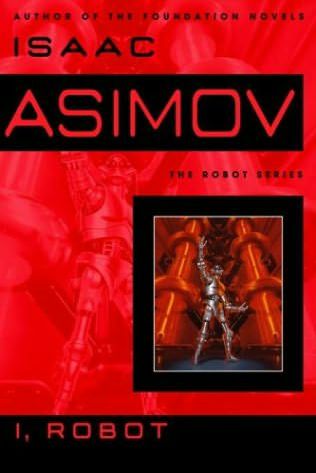
Cover Rating: 4 out of 5. I like the red and black, and the robot is good. The background is okay, although I wish that the actual title of the book was bigger than the author's name. I don't really like it when they do that.

Back cover:

They mustn't harm a human being, they must obey human orders, and they must protect their own existence . . . but only if doing so doesn't violate rules one and two. With these Three Laws of Robotics, humanity embarks on perhaps its greatest adventure: the invention of the first positronic man.

Isaac Asimov's I, Robot launches readers on an adventure into a not-so-distant future where man and machine struggle to redefine life, love, and consciousness itself. For the scientists who invented the earliest robots weren't content that their creations should remain programmed helpers, companions, and semisentient workermachines. And soon the robots themselves, aware of their own intelligence, power, and humanity, aren't satisfied either. Now human men and women find themselves confronting telepathic robots, robot politicians, robots gone mad, and vast robotic intelligences that may already secretly control the world in the next great evolutionary struggle for survival. And both man and robot are asking the same questions: what is human? And is humanity obsolete?

My expectations: were high. And they were met. :)


This book is based on the fact robots run on the Three Laws of Robotics, as said above. They are:


1. A robot must not injure a human being, or, through inaction, allow a human being to come to harm.
2. A robot must obey orders given to it by human beings except where such orders would conflict with the First Law.
3. A robot must protect its own existence as long as such protection does not conflict with the First or Second Laws.


   Digest that. All of the chapters/stories are based on those laws, and it can result in many strange scenarios you really wouldn't think possible. This book gets abstract at times--when explanations come in about figuring out the equilibrium between the first, second, and third laws, outsmarting the smartest objects on Earth and beyond, and arguing with a robot about spirituality of all things, sometimes I had to more slowly than I usually do through a book. But it was really, really interesting, and the cast of characters was varied, which I liked.


   There's Dr. Susan Calvin, robopsychologist. She's a little cold, a little strange, very smart, and I like her no-nonsense attitude. I got a little irked when she started acting funny around Milton Ashe, but that smoothed itself out.


   Byerly was one of my favorites. He/it is smart, calm, and reasonable. I thought the cripple was a mystery (I like mysteries) which never really got explained, but I don't particularly mind that being left a loose end. I'm not sure--no one's sure, really--whether the summary on the book gives something away, but it might. Or it might not.


   Mike Donovan and Gregory Powell . . . well, I can't help but find their predicaments funny. They get stuck with the worst of luck. They get stuck on a ship, they get stuck being in charge of robots who march like soldiers, Powell is forced to risk his life, they are continually put into precarious situations.


   All in all, this is a well-written piece of science fiction with diverse settings, a really good plot, interesting ideas, and I like the dialogue. (I love good conversations.) It's actually given me some inspiration for my own book, and I love it when my reading gives me ideas. :)


Other: no bad language in this book. I think they might have used the d-word once or twice, but I can't remember anything specific . . . They do use phrases describing the character's speech like "colorful" and "derogatory" but that's it. Nothing terrible.


I read a take on this story called I, Rowboat, (short story) who I can't remember the author of. But now I can understand just what they were talking about more clearly.


Do I recommend this book? Absolutely! I'd say I'd send Speedy after you if you don't, but that would violate the First Law, wouldn't it? ;)


-----The Golden Eagle