Showing posts with label Quantum Physics. Show all posts

26 April, 2013

A To Z Challenge: Wave-Particle Duality

Unlike almost every other letter of the alphabet, W has no corresponding scientific field of study. So I kind of sat in front of my computer for an hour trying in vain to come up with some kind of subject--and ended up going with wave-particle duality. Again. Because it's a somewhat recent development (physics-wise) and a fascinating subject.

Double-slit experiment, with the interference pattern on the right
and the two vertical slits in the center as S2. CC BY-SA 3.0,
via Wikimedia Commons
Wave-particle duality, which I touched on in my post Quantum Physics, is when a particle acts as both a wave and a particle; light had long been thought to be a wave until certain experiments demonstrated particle-like qualities. One of the more famous experiments is the double-slit experiment, which demonstrates light's wave properties.

Richard Feynman came up with the following analogy: Imagine you're shooting at a wall, but between you and the wall is a sheet with two vertical slits. The logical assumption would be that the bullets would hit the wall in two corresponding vertical rows--but that isn't what happens with light. Instead, when you shine light at two vertical slits, it builds up in an interference pattern (several bright and dark bands), which is a characteristic of waves, not particles.

**********

Sources:
http://www.britannica.com/EBchecked/topic/637889/wave-particle-duality
http://www.colorado.edu/physics/2000/schroedinger/two-slit3.html
http://physics.about.com/od/lightoptics/a/doubleslit.htm
http://www.thefreedictionary.com/wave-particle+duality
http://hyperphysics.phy-astr.gsu.edu/hbase/mod1.html

**********

When you think about light, do you tend to think of it as a wave or a particle? 


-----The Golden Eagle

24 April, 2013

A To Z Challenge: Unified Theory And Unraveling The Universe's Mysteries

Unified theory, also known as Grand Unified Theory (GUT) or the Theory of Everything (TOE), is the name for an as-yet undiscovered theory that would unite all the known physical forces into one complete theory. Since Albert Einstein physicists have been attempting to combine gravitation, the strong nuclear force, the weak nuclear force, and electromagnetism, and by so doing discover a fundamental equation or system that governs the universe.

One theory that holds promise toward producing a unified theory is M-theory. Gathering the attention of physicists like Stephen Hawking and Brian Greene, M-theory is the unification of five separate string theories, which it can combine by adding an additional 11th dimension. It's still being hashed out--but string theory has potential to successfully combine all known forces into one.

**********

Sources:
http://www.britannica.com/EBchecked/topic/614522/unified-field-theory
http://physics.about.com/od/physicsmtop/g/M-Theory.htm
http://www.damtp.cam.ac.uk/research/gr/public/qg_ss.html
http://www.thefreedictionary.com/M-theory
http://www.latimes.com/news/science/sciencenow/la-sci-sn-stephen-hawking-cedars-sinai-20130410,0,7704203.story
http://phys.org/news/2011-03-elegant-multiverse-professor-brian-greene.html

**********

Do you think scientists will develop a unified theory/GUT/TOE within the next few decades? Do you think it will have a effect on society, or that we haven't achieved enough to really take advantage of a fundamental theory?


-----The Golden Eagle

19 April, 2013

A To Z Challenge: Quantum Physics And Quandaries Of The Universe (+ A Book Release: The Other Marlowe Girl)

Quantum mechanics, also known as quantum physics, is a field of study involving physics which cannot be explained through classical methods, such as Newtonian physics. Some extremely weird phenomena occurs in quantum mechanics, including--but not limited to--things appearing and disappearing at random moments and photons being both waves and particles.

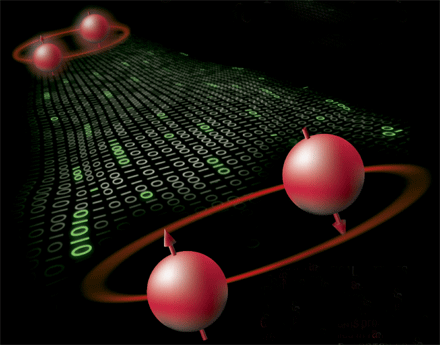
This month, some interesting findings regarding a thing called quantum entanglement have been published. Quantum entanglement's premise is as follows: When two particles (let's say photons) are entangled, it means that when one or both of the photons is observed (i.e. measured) they assume opposite positions, such as one photon being up and the other down.

The interesting thing about the interaction is that before either of the photons is observed, they are considered to be in all possible states at the same time--therefore, when one photon falls into one state (such as the down state) upon observation, the other photon will fall into the complementary state (the up state). This means information travels between the two particles faster than the speed of light, which caused Einstein to call it "spooky action at a distance". The recent report closes three loopholes in this theory that could have poked holes in quantum entanglement, which serves to shore up the theory and affirm that, indeed, particles really are communicating between themselves about their different states.

**********

Sources:
http://www.thefreedictionary.com/quantum+mechanics
http://www.pbs.org/transistor/science/info/quantum.html
http://www.livescience.com/28808-spooky-quantum-entanglement-loophole-closed.html
http://www.livescience.com/28550-how-quantum-entanglement-works-infographic.html
http://www.itechpost.com/articles/8022/20130418/quantum-mechanics-physics-loophole-photons-experiment-lasers-einstein-theory-of-relativity.htm
http://www.sciencedaily.com/releases/2013/04/130415094839.htm

**********

And now, for a belated book release. In the madness of the A to Z Challenge, I thought this book release post was supposed to go up next Monday, when it was really supposed to be up last Monday. I apologize for the mistake--hope you can forgive me, Beth! And I hope this post can still do some good going up now.


Meet Beth Fred! That's me! I'm a full time ELF keeper and part time writer/blogger/writing instructor. I'm represented by Kathleen Rushall of Marsal Lyons Literary Agency. I like my tea hot, my romance sweet, and my guys chivalrous. Real men hold open doors, refer to you as ma'am, make promises they keep, and aren't afraid to profess their undying love. It's not breakfast if there aren't carbs(at least, not in the South). Fajitas, carnitas, and churros are just few of my favorite things. Bet you can't guess where I'm from ;) Wanna know more about me? You can find that here:

Email me: bethfred08(at)gmail.com
Blogger:  bethfred.com
Tweet me: bethfred08
FB Author Page: https://www.facebook.com/bethfred08


Available at: Amazon & Smashwords
When twenty-four-year-old Tiffany escapes her sister Kammy's too wild Cancun bachelorette party, she finds herself in a bar with the unwanted attention of a gorgeous local named Luke.

Luke may be charming but Tiffany is leaving in two days and doesn't need any complications. But complications are exactly what she gets when the cops show up to raid Kammy's party. When Kammy is arrested, Tiffany agrees to have dinner with Luke, so he'll help her get Kammy out of jail. Kammy's arrest forces her to spend an extra day in Cancun, meaning she'll miss a crucial meeting, and as an accountant in tax season, she is already drowning in work. Not to mention, every second she spends with Luke makes it harder to leave. With Luke, Tiffany can forget about work.

But will the airport be their final goodbye?

ebook, 42 pages
Published September 12th 2012 by Amazon
ASINB0096PWTUO
edition language: English
original title: Kismet

Available at: Amazon
When twenty-four-year-old dance school drop out Kammy Marlowe is evicted by her mother, she goes to her favorite bar. She finds an unlikely friend in the blunt eye candy, Enrique. But Kammy knows there is no way she and Enrique have a shot because he's her brother-in-law’s brother and has been privy to her wild past.

Enrique swears he’s only interested in the person she is today, but their relationship is tested when her ex-husband's drug dealer attacks her, looking for money. With no options and a money hungry drug dealer on her back, Kammy accepts a position as a dancer at a strip club. But when Enrique shows up at the club, their relationship is over. With no reason to stay in Texas anymore, Kammy auditions for the Bolshevik Ballet and gets the opportunity to go to Russia. Only Enrique is determined to stop her.

Will she give up the chance of a lifetime to stay with the man she still loves?


Ebook: 107 pages
Published: April 5th 2013
edition language: English


**********

Do you agree with Einstein's description of quantum entanglement as "spooky action at a distance"? Some scientists have accomplished minor teleportation using entanglement; would you agree to being teleported using quantum mechanics, if they succeeded at transporting things larger than individual particles?

Have you read any of Beth Fred's books?


-----The Golden Eagle

26 April, 2012

A-Z Blogging Challenge: Wave-Particle Duality

Example of a double slit experiment, by Timm Weitkamp,
CC-BY-3.0-de. SOURCE.
Wave-particle duality is a principle of quantum physics that says matter and light act as both waves and particles, and that the observed behavior depends on the experiment.

Since the 1600s, scientists tried to figure out whether light, a type of electromagnetic radiation, came in waves or was made up of particles. Christiaan Huygens developed a wave theory (also suggesting that there was a luminiferous ether through which waves traveled, since it was generally thought waves needed a medium) and Isaac Newton a particle (or corpuscular) theory. It wasn't until the 1800s with Thomas Young's double-slit experiment and the buildup of other evidence pointing toward the fact light acted like a wave that Newton's theory was overturned. At least until the Michelson-Morley Experiment, which tried and failed to find any ether.

There are six major types of light phenomenon: reflection, refraction, interference, diffraction, polarization, and the photoelectric effect, all of which can be explained by wave theory, except for the photoelectric effect. Then Albert Einstein published a paper that explained it (introducing photons as continuous waves in 1905), wave-particle duality was also proved to take place with matter by Louis de Broglie (who was awarded the Novel Prize in 1929), and Niels Bohr proposed that light could take on either wave or particle characteristics. Hence, with no other explanation, duality was accepted as reality.

Example of an interference pattern, by Thierry Dugnolle,
public domain image. SOURCE.
One of the more famous experiments done which helped prove wave-particle duality was Young's Double Slit Experiment. To take Richard Feynman's analogy, imagine someone shooting at a wall through two slits in a sheet of metal. You would expect the bullets to be centered close to two narrow bands on the far wall--but with light, that isn't true. Instead (to stretch the example a bit far) the pattern of bullets would show up as an interference pattern (bright and dark bands, in the case of light; see above image) as though projectiles were passing through the slits at the same time and bouncing off each other.

No notable scientist today. Quantum physics is far from stagnant, of course, but I don't know of any wave-particle dualicists. But if you'd like a simulated ripple tank to play around with that has an example of the double-slit experiment (just make sure you have Java):

http://www.falstad.com/ripple/ex-2slit.html

**********

Sources:
http://www.britannica.com/EBchecked/topic/637889/wave-particle-duality
http://www.colorado.edu/physics/2000/schroedinger/two-slit3.html
http://hyperphysics.phy-astr.gsu.edu/hbase/mod1.html
http://library.thinkquest.org/28383/nowe_teksty/htmla/2_10a.html
http://micro.magnet.fsu.edu/primer/java/interference/doubleslit/
http://physics.about.com/od/lightoptics/a/doubleslit.htm
http://physics.about.com/od/lightoptics/a/waveparticle.htm
http://science.howstuffworks.com/light6.htm
http://www.supraconductivite.fr/en/index.php?p=supra-quantique-dual
http://www.thefreedictionary.com/wave-particle+duality
http://www.upscale.utoronto.ca/PVB/Harrison/DoubleSlit/DoubleSlit.html

**********

Do you think any other strange properties such as wave-particle duality will be discovered?


-----The Golden Eagle

19 April, 2012

A-Z Blogging Challenge: Quantum Physics

A black body. Public domain image. SOURCE.
Quantum physics is a branch of physics that deals with quanta (discrete units of energy) as described by quantum theory.

The name quantum comes from the Latin word for "how much". This field was developed because classical (or Newtonian) physics doesn't apply to atomic particles; radiation from black bodies (a black body absorbs and then emits all radiation that reaches it) could not be explained by it, or by electromagnetic theory. In 1900, Max Planck came up with a theory that explained the radiation from observed black bodies, and it proposed that electromagnetic radiation comes in quanta.

There are several important ideas to quantum physics:

1. The Copenhagen Interpretation. Created by Niels Bohr, it states that nothing exists until it is measured.
2. The collapse of the wave function. The wave function--which was created by Erwin Schrodinger--of a particle "collapses" into one of all possibilities when observed.
3. The Heisenberg Uncertainty Principle. Invented by Werner Heisenberg, the principle explains that either the momentum or the position of a particle, but not both, can ever be determined.
4. The EPR Paradox. Named after Albert Einstein, Boris Podolsky, and Nathan Rosen, it was an attempt to dismantle the Copenhagen Interpretation; the basic idea is that if a pair of particles have opposite spin and you measure one of the two, the other particle immediately acquires the opposite spin, faster than the speed of light.
5. The infinity problem. This is a mathematical hang-up where in quantum electrodynamics (QED), if you try to solve Schrodinger's aforementioned wave function, you end up with an electron with infinite mass, energy, and charge, a clear impossibility.

But that's not all. Due to problems with the Copenhagen Interpretation, there is another, competing quantum theory. The Many Worlds Theory, presented by Hugh Everett III in 1957, proposes that there are as many universes as there are possibilities; that every time a measurement is taken, the universe splits into one where the measurement occurred, and many more where the measurement resulted with all the other probabilities. In the case of a particle with two possible states, the universe would divide twice.


By Markus Poessel (Mapos), CC-BY-SA-3.0. SOURCE.
Notable Physicist:

Brian Greene


Brian Greene is a professor of physics and mathematics at Columbia University who obtained a Ph.D. from Oxford University. He made a series of discoveries in superstring theory (which tries to bring together quantum theory and general relativity into a single unified theory) and topology change (the idea that the fabric of space can split). He is the author of The Elegant Universe, The Fabric of the Cosmos, The Hidden Reality, and Icarus at the Edge of Time. He was the host of the PBS NOVA programs The Elegant Universe and The Fabric of the Cosmos, both based on his books. He also co-founded the annual World Science Festival in 2008.


A short video of Brian Green explaining quantum physics:


**********

Sources:
http://www.briangreene.org/?page_id=39
http://www.columbia.edu/cu/physics/fac-bios/Greene/faculty.html
http://hyperphysics.phy-astr.gsu.edu/hbase/mod6.html
http://library.thinkquest.org/3487/qp.html
http://physics.about.com/od/quantumphysics/p/quantumphysics.htm
http://www.quantumintro.com/
http://srikant.org/core/node12.html
http://www.thebigview.com/spacetime/quantumtheory.html
http://www.thefreedictionary.com/quantum+physics
http://www.thekeyboard.org.uk/Quantum%20mechanics.htm

**********

So, which do you champion: the Copenhagen Interpretation or the Many Worlds Theory? Do you think we'll ever find a definitive answer?


-----The Golden Eagle

07 April, 2012

A-Z Blogging Challenge: General Relativity

Public domain image. SOURCE.
General relativity describes gravity as curved space created by the existence of mass.

It was invented by Albert Einstein in 1916, who expanded his Special Theory to include gravity's effect on spacetime. The Special Theory, published in 1905, stated that the speed of light is the same no matter where or how you're observing it, and that observers moving at a constant speed should encounter identical physical laws.

The theory of general relativity has been backed up by several observations. In 1919, during a solar eclipse, scientists discovered that light was bent around the sun (known as gravitational lensing) to the exact degree of Einstein's theory; general relativity also accounted for the small changes in Mercury's elliptical orbit, which had gone unexplained by Isaac Newton's theory of gravity. Furthermore, gravitational redshift (where photons--light--lose their energy and move toward the red end of the spectrum) has also been observed.

Gravity waves (waves or "ripples" in spacetime) predicted by the theory have not been recorded to date, though the Laser Interferometer Gravitational Wave Observatory (LIGO) is currently looking for them.

Public domain image. SOURCE.
Notable scientist who has studied general relativity:

Michio Kaku

Michio Kaku is a theoretical physicist who graduated from the University of California, Berkeley, and currently holds the Henry Semat Chair and Professorship in theoretical physics. He teaches at the City College of New York and has been a visiting professor at New York University and the Institute for Advanced Study, Princeton. He is the host of the two shows Visions of the Future and The Universe, along with the host of two radio programs Science Fantastic and Explorations in Science. His books include Beyond Einstein, Visions, Einstein's Cosmos, Parallel Worlds, and Physics of the Impossible: A Scientific Exploration of the World of Phasers, Force Fields, Teleportation, and Time Travel.

His current work involves unifying the four fundamental forces--electromagnetism, strong force, weak force, and gravitation--and string theory, which he co-founded.

Video of Michio Kaku:


**********

Sources:
http://archive.ncsa.illinois.edu/Cyberia/NumRel/GenRelativity.html
http://archive.ncsa.illinois.edu/Cyberia/NumRel/SpecialRel.html
http://astro.physics.sc.edu/selfpacedunits/Unit57.html
http://www.astro.ucla.edu/~wright/bh-st.html
http://www.astro.ucla.edu/~wright/relatvty.htm
http://www1.ccny.cuny.edu/prospective/science/profiles/Kaku-Profile.cfm 
http://www-history.mcs.st-and.ac.uk/HistTopics/General_relativity.html
http://mkaku.org/home/?page_id=5
http://www4.ncsu.edu/unity/lockers/users/f/felder/public/kenny/papers/gr1.html
http://www.pbs.org/wgbh/nova/physics/relativity-and-the-cosmos.html
http://simplycharly.com/einstein/michio_kaku_interview.htm
http://scienceworld.wolfram.com/biography/Einstein.html
http://scienceworld.wolfram.com/physics/GeneralRelativity.html

**********

Do you think string theory is the answer to the lack of unity between general relativity and quantum theory?


-----The Golden Eagle

23 April, 2011

A-Z Blogging Challenge: T Stands For: Teleportation

Teleportation usually comes across as a science fiction mechanism of traveling interstellar distances instantaneously, between planets, from ships, to bases, and etc. But while it isn't as grand or as immediately obvious as a person being teleported across space, quantum teleportation (a bit different from transfer of actual matter) has been done by scientists.


Quantum teleportation, also called entanglement-assisted teleportation, is when a unit of quantum information or "qubit" is transmitted from one place to another, without that qubit crossing the space between the two points. It doesn't physically transport any matter or information, and no particles are reassembled at the second location.


Scientists are capable of doing this because of quantum entanglement, which is when particles are linked to each other even when physically separated, share a single quantum state, and remain in quantum superposition (the idea the particles can be two things at the same time--this links to the idea of Schroedinger's cat of being both alive and dead) until a measurement is taken. Because the particles are entangled, and in two states at once, in theory the measurement of one would immediately affect the other, faster than the speed of light. Albert Einstein called this "spooky action at a distance".


Some uses for this technology? Quantum teleportation could be used for communications. It could allow transmission of large amounts of information, speed up quantum computation, and perform tasks impossible for classical systems.

*****

Sources:
http://www.time.com/time/health/article/0,8599,1874760,00.html
http://www.livescience.com/7647-teleportation-milestone-achieved.html
http://en.wikipedia.org/wiki/Teleportation
http://en.wikipedia.org/wiki/Quantum_teleportation
http://www.jqi.umd.edu/news/211-entanglement-with-frequency-combs.html
http://www.research.ibm.com/physicsofinfo/members/teleportation.htm
http://en.wikipedia.org/wiki/Quantum_entanglement
http://plato.stanford.edu/entries/qt-entangle/#2
http://www.quantum.at/research/quantum-teleportation-communication-entanglement/first-quantum-teleportation.html
http://www.quantiki.org/wiki/Quantum_communication

*****

Do you think we'll be using quantum technology in the relatively near future? Do you think teleportation will ever reach the point where people, or even just macroscopic objects, could be transported from one place to the other?

And please, PLEASE don't quote Star Trek. I've read enough articles researching this post with the phrase stuck in there somewhere. :P

-----The Golden Eagle

20 April, 2011

A-Z Blogging Challenge: Q Stands For: Quantum Mechanics

Ready for another science post, everyone? :)


Quantum mechanics is a branch of physics dealing with wave-particle duality. Wave-particle duality is when matter acts like both a wave (think liquid) and a particle (think atoms). Quantum mechanics describes a physical system through a wavefunction, which predicts the chances of a particle being in a certain state at a certain time. This sort of probability is called probability amplitude.


The thing about the wavefunction is that the more you try to calculate one part of the system, the less accurate your measurements will be with regards to another part of the system. This is called the Heisenberg Uncertainty Principle.

(Good ol' Heisenberg. SOURCE)

The uncertainty principle brings into question the role of the observer. The Copenhagen Interpretation is the standard interpretation of measurement, the "statistical nature of reality", and the philosophical debate over what effect an observer has over a system. It says that observation causes the wavefunction to collapse; also referred to as consciousness causes collapse. One of the more famous thought-experiments to demonstrate this sort of thing is the Schroedinger's Cat experiment. (In which no live cats were harmed, by the way. Just thought-experiment ones.)


But there are other ideas on how quantum mechanics works. There's the Many Worlds Theory, Consistent Histories, Ensemble Interpretation, de Broglie-Bohm Theory, Relational Quantum Mechanics, Transactional Interpretation, Stochastic Mechanics, Objective Collapse Theories, von Neumann/Wigner Interpretation, Many Minds, Quantum Logic, Modal Interpretations, Time-Symmetric Theories, the list goes on and on.

Obviously, there's a lot of figuring out to do.

*****

Sources:

*****

No question this time. You have the floor on quantum mechanics!


(Also, I won't be around to your blogs today. I'll do my best to catch up with posts tomorrow, and I'll be sure to swing by anyone who comments here.)

-----The Golden Eagle

19 April, 2011

A-Z Blogging Challenge: P Stands For: Particle Physics

Particle physics is a branch of physics that studies the elementary particles of matter and radiation. An elementary, also called fundamental, particle is something that has no substructure--it is not made up of smaller particles. Particle physics is also referred to as high energy physics, because fundamental particles can only be created in particle accelerators.


The classification of all those particles comes together in the Standard Model. The Standard Model has only twelve basic particles, which are governed by four forces.

The twelve matter particles are quarks and leptons. Each of these two groups has "generations"--the first generation being lighter and more stable, while the second and third are heavier and less stable. All the stable matter in the universe belongs to the first generation, because the particles that make up the second and third decay to a more stable level.


There are up quarks, down quarks, charm quarks, strange quarks, top quarks, and bottom quarks, to cover the first six out of the twelve. Then there are electrons, electron-neutrinos, muons, muon-neutrinos, taus, and tau-neutrinos.


Three of the four fundamental forces--the strong force, the weak force, the electromagnetic force, and the gravitational force--result because of the exchange of "force carrier particles", called bosons. Fundamental particles exchange these bosons and, therefore, discrete amounts of energy. The strong force is carried by the gluon, the weak force by the W and Z bosons, the electromagnetic force by the photon, and the graviton for the gravitational force has not been found yet.


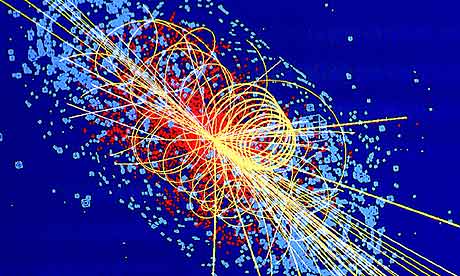
And last but not least, there's the Higgs Boson, which is thought to be the reason other particles have mass. The boson is predicted to exist because of the Standard Model, which incorporates it to solve problems with current theoretical physics. Experiments are being done to prove its existence with the Large Hadron Collider at CERN and Tevatron at Fermilab (although the latter will cease operations in September), but it has yet to be observed.


*****

A very cool video on the Standard Model (the scientists probably explain things way better than I do):


Sources:
http://public.web.cern.ch/public/en/science/StandardModel-en.html
http://en.wikipedia.org/wiki/Standard_model
http://particleadventure.org/index.html
http://en.wikipedia.org/wiki/Elementary_particle
http://en.wikipedia.org/wiki/Particle_physics
http://en.wikipedia.org/wiki/Higgs_boson
http://en.wikipedia.org/wiki/Tevatron
http://www.universetoday.com/26829/fermilab-putting-the-squeeze-on-higgs-boson/

*****

What do you think of particle physics? Do you think the Higgs boson will be found soon? Do you think the Standard Model, despite the fact it omits gravity from the calculations, will continue to be the way scientists describe fundamental particles?


-----The Golden Eagle
Enhanced by Zemanta

04 April, 2011

A-Z Blogging Challenge: C Stands For: Cold

There's a limit to cold.

0 Kelvin degrees (-273.15 C/-459.67 F) is absolute zero, the point where thermal energy effectively disappears, even if the kinetic energy doesn't. Matter begins to act strange at those extremely low temperatures, presenting quantum effects such as superconductivity and superfluidity. This is due to the Bose-Einstein condensate, which is a state of matter of weakly interaction bosons, within a confined external potential.

Basically, "A new form of matter at the coldest temperatures in the universe", if you'd like the explanation from the website.

Phenomenon caused by absolute zero temperatures:

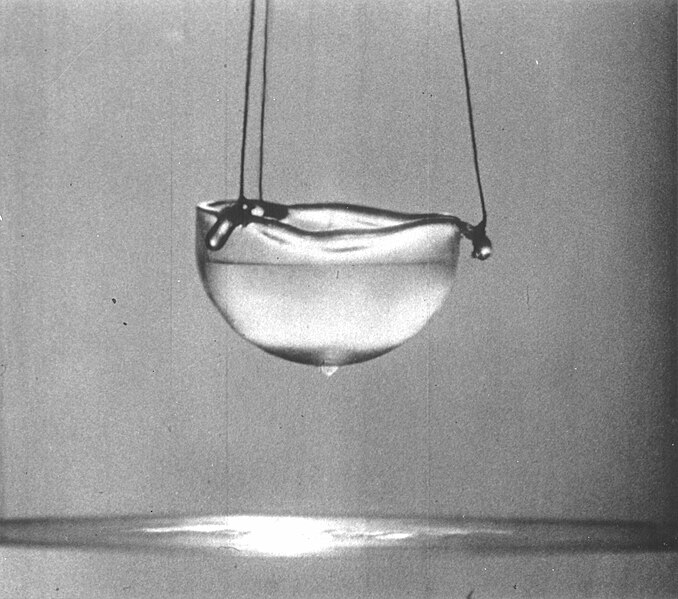
Superfluidity. At temperatures very, very close to absolute zero (they have't gotten all the way down, if that's even humanly possible) matter acts as if it has no viscosity at all, and that allows it to flow literally anywhere--including up, for gravity doesn't affect things with zero viscosity.

An example of superfluid going up and over:

(SOURCE. See the liquid at the bottom? It went up and over the rim of the bowl.)

Superconductivity. This is the state of zero electrical resistance. One fascinating property of this is that if there is electricity flowing through a superconducting wire, it will continue flowing indefinitely, provided the wire stays below a critical temperature.

An example of a magnet levitating due to superconductivity (Meissner effect):


*****

To learn more about cold, go HERE to check out the NOVA program website.

Sources:
http://en.wikipedia.org/wiki/Bose%E2%80%93Einstein_condensate
http://en.wikipedia.org/wiki/Superfluidity
http://en.wikipedia.org/wiki/Superconductivity
http://www.colorado.edu/physics/2000/bec/

*****

Thoughts?


-----The Golden Eagle
01 April, 2011

A-Z Blogging Challenge: A Stands For: Astrophysics

Astrophysics is:

"The branch of astronomy that deals with the physics of the universe, including the physical properties (luminositydensitytemperature, and chemical composition) of celestial objects such as galaxiesstarsplanetsexoplanets, and the interstellar medium, as well as their interactions."


Solar System Planets.Image via Wikipedia

Fascinating stuff, astrophysics.


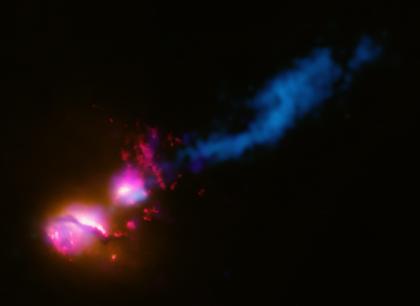
Especially once you start thinking about just how many discoveries that could still be made about the universe. We know practically nothing about dark matter and dark energy (aside from the fact it exists); there are countless stars that could have exoplanets (and, therefore, the potential for alien life); black holes (which could be at the center of every galaxy in our universe); star-forming regions such as nebulae (which are sometimes also the leftover matter from exploding stars); and the galaxies themselves, which collide and interact (as the Milky Way will with Andromeda, some billions of years from now).


And who knows, maybe in the future people will be exploring the universe beyond this solar system, traveling to other stars, exploring satellites and creating a new frontier in space. There's no telling what could happen if Earth becomes one of two, or several, or many other planets that could sustain human life and we have the technology to take us there.


Ahem.


Can you tell I read and write and love Science Fiction?


*****

And if you want some videos to watch to learn more about astrophysics:


Monster of the Milky Way NOVA Program
Hunting the Edge of Space NOVA two-part series
Origins of the Solar System NOVA Program 


Sources:
http://en.wikipedia.org/wiki/Astrophysics


*****

What do you think of astrophysics? Do you think any major discoveries about the universe will be made in the near future?


-----The Golden Eagle

Enhanced by Zemanta

02 July, 2010

The Copenhagen Interpretation vs. The Many-Worlds Interpretation

Now, in quantum physics, there is such a thing as superposition. Basically, it means that if something goes unmeasured, then its position can be in many places at once, and is therefore in several places at once. Take Chad Orzel's example:

If there are two boxes, then there is the probability that a treat is either in the left box, or the right box. (Please ignore the doggy examples; the book is based on them) Therefore, until you go over and actually check the box, then it is in both boxes at the same time.

Now, the Copenhagen Interpretation says that something called "collapse" happens when something "measures" the position of the object, in this case, a treat. Collapse is when the object lands in one of the allowed states, in this case, either the right box or the left box. Now, people argue over what counts as an "observer"; humans, dogs, insects? They argue over why an "observer" should have any effect at all over a quantum object.


The quantum-mechanical "Schrödinger's cat...Image via Wikipedia
The other explanation for this phenomenon is the "many-worlds" interpretation; basically, the wavefunctions of the objects turn "decoherent" and the two wavefunctions are no longer "interfering." Basically, a new branch of the universe is created for every possible outcome, if you want it in a nutshell. This is the basis for many fiction books, where universes branch off from one another.

One example of this occurences is the Shroedingers Cat thought experiment. A cat is placed in a box with uranium that has a 50% chance of decaying. If it decays, then gas is released, killing the poor kitty. If no decay occurs, then no gas is released and the cat lives. Shroedinger proposed that a different universe was created in that instant, one where the cat lived, and one where the cat died. We exist in both.

Both of these theories--the Copenhagen Interpretation and the Many-Worlds theory--give you the same result: the object is either there, or it isn't there, and that's the end of it. We have no control over the probability or what wavefunction our lives work in. That's the basis of the "shut up and calculate" theory, possibly said by the well-known physicist Richard Feynman.

Feynman (center) with Robert Oppenheimer (righ...Image via Wikipedia
Enhanced by Zemanta
-----The Golden Eagle
P.S. I took the advice, and yes, Zemanta was helpful! :)