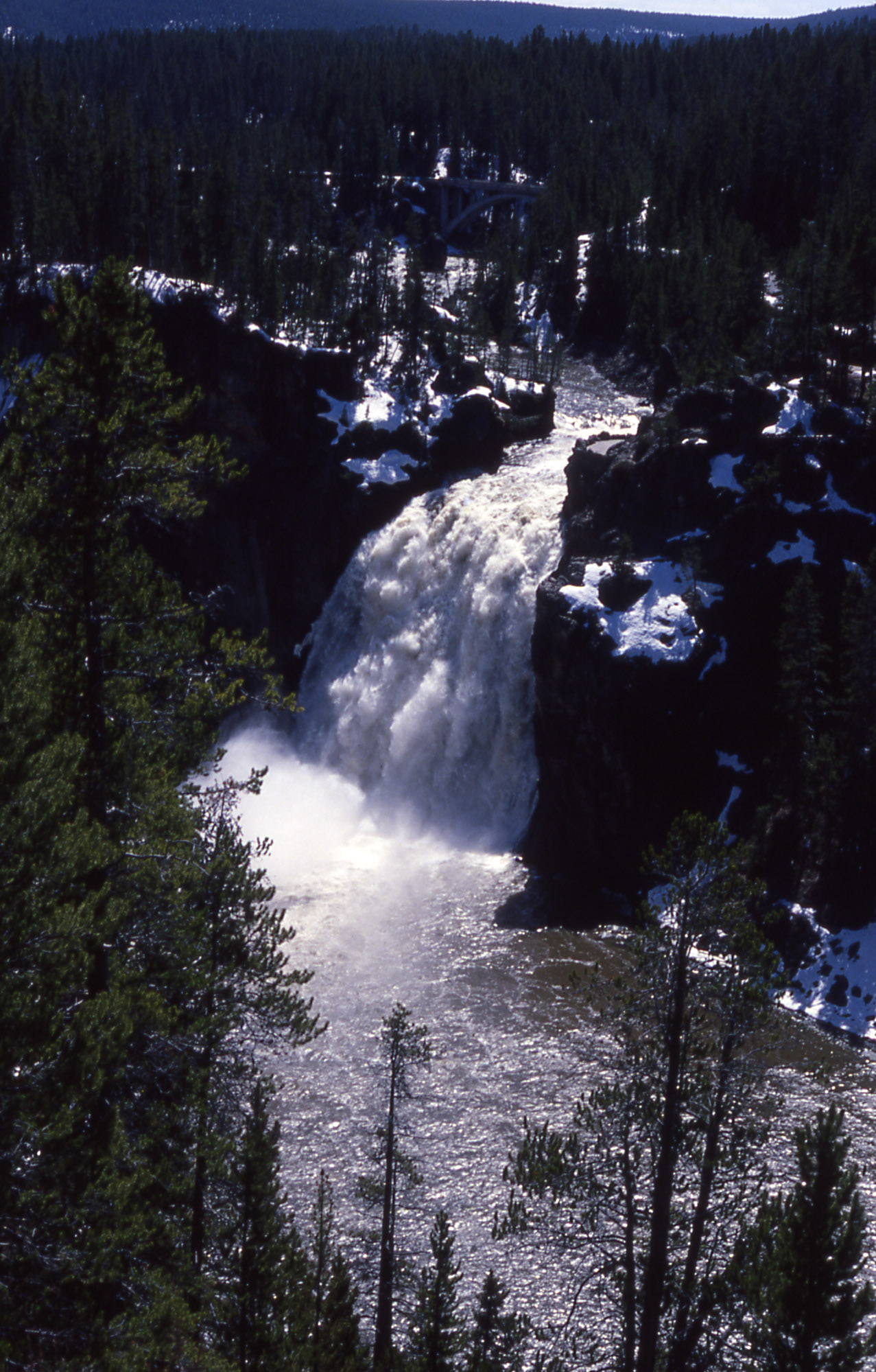
(Yellowstone River, Upper Falls. SOURCE)
The name "Yellowstone" came from the Minnetaree (a Native American Indian tribe) word for a river with yellow sandstone bluffs: "Mi tsi a-da-zi". French trappers interpreted this as "Yellow Rock River", and called it "Pierre Jaune" or "Roche Jaune". Lewis and Clark came into contact with the same tribe, and also called it Yellow Rock River.

(Canada Lynx. SOURCE)
Yellowstone National Park is home to several threatened endangered species, including the Canada Lynx, the gray wolf, and the grizzly bear. Some other notable animals are the American bison, bighorn sheep, bobcats, coyotes, elk, moose, mountain lions, mule deer, to name the large ones. 67 mammal species live in the park (the largest concentration in the 48 states), 322 species of birds are recorded (148 of them nesting in the park), 16 species of fish (although 5 of them are non-native), 6 reptile species, and 4 species of amphibians. There are also 7 conifer species, 1,100 native species of plants, 199 non-native species of plants, 186 species of lichens, and 406 species of thermophiles.

(SOURCE)
The Yellowstone Caldera is the largest supervolcano in North America. It is indeed considered an active volcano, producing half the world's volcanic activity. The caldera has been measured at 55 km (34 miles) by 72 km (45 miles) in size, although a new survey has shown it could extend for up to 640 km (400 mi) east to west.

(SOURCE)
Three supereruptions have happened in Yellowstone's history--at 2.1 million, 1.3, and 640,000 years ago. The last time Yellowstone exploded, it sent 1,000 cubic km (240 cubic mi) of dust into the air, and if it was to erupt again (supervolcano eruptions are predicted to happen sometime in the future; in fact, we're overdue) it could bury North America in ash and disrupt life around the globe.

(SOURCE)
They say it won't be happening anytime soon. But, obvious in the recent catastrophes, the prediction of earthquakes, volcanoes, and other natural disasters is shaky at best.
*****
Source:
http://www.nps.gov/yell/index.htm
http://www.yellowstone-natl-park.com/history.html
http://www.nps.gov/yell/planyourvisit/factsheet.htm
http://en.wikipedia.org/wiki/Yellowstone
http://www.yellowstone-online.com/history/yhtwo2.html
http://www.visityellowstonepark.com/Park-Facts.aspx
http://www.nps.gov/yell/naturescience/mammals.htm
http://en.wikipedia.org/wiki/Animals_of_Yellowstone
http://www.nps.gov/yell/parkmgmt/bisoneiscon5.htm
http://www.livescience.com/200-super-volcano-challenge-civilization-geologists-warn.html
http://www.huffingtonpost.com/2011/04/13/yellowstone-supervolcano-2011_n_848681.html
*****
Do you think supervolcano eruptions are something we should be worried about? Do you think Yellowstone will erupt in the near future, or do you think this is just a bunch of pointless speculation?
Also, have you ever been to Yellowstone?
-----The Golden Eagle

