Showing posts with label The Copenhagen Interpretation. Show all posts

20 April, 2011

A-Z Blogging Challenge: Q Stands For: Quantum Mechanics

Ready for another science post, everyone? :)


Quantum mechanics is a branch of physics dealing with wave-particle duality. Wave-particle duality is when matter acts like both a wave (think liquid) and a particle (think atoms). Quantum mechanics describes a physical system through a wavefunction, which predicts the chances of a particle being in a certain state at a certain time. This sort of probability is called probability amplitude.


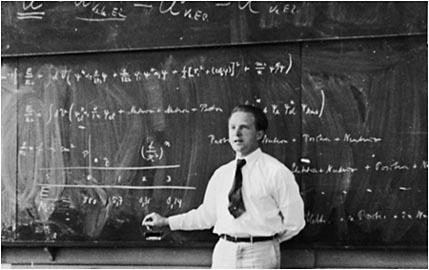
The thing about the wavefunction is that the more you try to calculate one part of the system, the less accurate your measurements will be with regards to another part of the system. This is called the Heisenberg Uncertainty Principle.

(Good ol' Heisenberg. SOURCE)

The uncertainty principle brings into question the role of the observer. The Copenhagen Interpretation is the standard interpretation of measurement, the "statistical nature of reality", and the philosophical debate over what effect an observer has over a system. It says that observation causes the wavefunction to collapse; also referred to as consciousness causes collapse. One of the more famous thought-experiments to demonstrate this sort of thing is the Schroedinger's Cat experiment. (In which no live cats were harmed, by the way. Just thought-experiment ones.)


But there are other ideas on how quantum mechanics works. There's the Many Worlds Theory, Consistent Histories, Ensemble Interpretation, de Broglie-Bohm Theory, Relational Quantum Mechanics, Transactional Interpretation, Stochastic Mechanics, Objective Collapse Theories, von Neumann/Wigner Interpretation, Many Minds, Quantum Logic, Modal Interpretations, Time-Symmetric Theories, the list goes on and on.

Obviously, there's a lot of figuring out to do.

*****

Sources:

*****

No question this time. You have the floor on quantum mechanics!


(Also, I won't be around to your blogs today. I'll do my best to catch up with posts tomorrow, and I'll be sure to swing by anyone who comments here.)

-----The Golden Eagle

01 October, 2010

Book Review: Going Bovine


Title: Going Bovine
Author: Libba Bray
Publisher: Delacorte Press
Genre: ?? I've seen it called Fantasy, YA Speculative, Adventure, Surrealdark Comedy, it could probably be called Paranormal, the NYT said she smashes the genre and grinds the tiny pieces into the sidewalk. So. You decide.
Page Count: 480
Rating: 5 out of 5
Cover Rating: 4 out of 5. Cow+gnome=perfect. I like the black too. The font's a little big, but they did get the author's name right. Bold, small, and at the top. It's visible, but it's not dominating the picture.

Inside flap:

All sixteen-year-old Cameron wants is to get though high school--and life in general--with a minimum of effort. It's not a lot to ask. But that's before h's given some bad news: he's sick and he's going to die. Which totally sucks.
    Hope arrives in the winged form of Dulcie, a loopy punk angel/possible hallucination with a bad sugar habit. She tells Cam there is a cure--if he's willing to do in search of it. With the help of Gonzo, a death-obsessed video-gaming dwarf, and a yard gnome who just might be the Viking god Balder, Cam sets off on the mother of all road trips through a twisted America of smoothie-drinking happiness cults, parallel-universe hopping physicists, mythic New Orleans jazz musicians, whacked-out television game shows, snow-globe vigilantes, and disenfranchised, fame-hungry teens into the heart of what matters more.

My expectations: High. I really, really liked The Gemma Doyle Trilogy, and Going Bovine did win the Michael L. Printz Award.

Despite that, it still managed to exceed my expectations.

About the book: It is EPIC. Everything is covered Going Bovine, it seems like. Death, life, love. How to live, why we're here, what's actually real. Plus, this book is funny and the characters are some of the best in a single book. It's very, very satisfying overall and I'm struggling here to think of a really weak spot.

The reason for the title? Cameron Smith has Creutzfeldt-Jakob disease, also known as mad cow disease, only it's the human version. It's incurable. He starts hallucinating--or so he thinks. Fire giants, angels, flames, all caused by what the doctor tells him are prions.

When I finished this book I had to meditate on it for a while. I do that for books that have really, strongly struck a chord with me, and believe me, this book did that. It was excellent.


  • Plot:

Hallucinations allow for some pretty amazing events to happen. This is one wild ride, from start to finish, and the situations they get themselves into are crazy. In the good way. It's a bit like The Hitchhiker's Quartet, only this time, Cam's set to die from the disease.

The ending is great. For a second I was thrown, and then the book just ended. It was abrupt, but I loved it.


  • Characters:

Cameron Smith is a jerk. But he's a lovable, dying jerk who's trying to figure out the insane situation around him and gets a little less-jerky as time goes on (I said a little). He wasn't one of my favorite characters, but he was perfect for the story. Stubborn, fiesty, and just willing to believe the crazy things Dulcie tells him.

I loved Dulcie. Go, punk rock angels! Her spunk, her attitude, her attire. Fabulous. She's strong, too.

Gonzo is, as it says in the synopsis, death-obsessed. If not death, health-obsessed. Fish? Poisons! Hotel room? Germs! Spot on his lung? Tumor! He takes everything to the extremes, but he was a good character.

Balder. Poor Balder, forced into clothes as a garden gnome and made to pose with passing tourists. He was a funny little gnome; I liked him.

There are plenty of other characters thrown in, and at a variety of places; they were all well-written.


  • Setting/Elements:

I LOVED the science aspect. 'Cause how many YA fiction books have physics in them? The Copenhagen Interpretation? Shrodinger's Cat? Parallel universes? Accelerators? Awesomeness, people. The scientists were depicted as being a little weird and maybe just a tad insane, but it wasn't a total stereotype.

The whole Cretzfeldt-Jakob disease thing is interesting; I hadn't known there was such a thing before, but I guess there is. I liked the way she put it into the story; is just the disease, a hallucination, or is it real?

Other: Language, drugs. There are a lot of drug references, and it mentions several times that Cameron has been "stoned" in the past. With the language, it's put in like it would be in a teenager's mind; seekers of really clean literature beware. There's also drinking/smoking, and some sex.

Do I recommend this book? Yes! Absolutely, and to people who read a wide range of genres.

(You have GOT to check out the site for the book, watch the interview, read about Putopia, and all that other good stuff: Going Bovine Website)

-----The Golden Eagle
02 July, 2010

The Copenhagen Interpretation vs. The Many-Worlds Interpretation

Now, in quantum physics, there is such a thing as superposition. Basically, it means that if something goes unmeasured, then its position can be in many places at once, and is therefore in several places at once. Take Chad Orzel's example:

If there are two boxes, then there is the probability that a treat is either in the left box, or the right box. (Please ignore the doggy examples; the book is based on them) Therefore, until you go over and actually check the box, then it is in both boxes at the same time.

Now, the Copenhagen Interpretation says that something called "collapse" happens when something "measures" the position of the object, in this case, a treat. Collapse is when the object lands in one of the allowed states, in this case, either the right box or the left box. Now, people argue over what counts as an "observer"; humans, dogs, insects? They argue over why an "observer" should have any effect at all over a quantum object.


The quantum-mechanical "Schrödinger's cat...Image via Wikipedia
The other explanation for this phenomenon is the "many-worlds" interpretation; basically, the wavefunctions of the objects turn "decoherent" and the two wavefunctions are no longer "interfering." Basically, a new branch of the universe is created for every possible outcome, if you want it in a nutshell. This is the basis for many fiction books, where universes branch off from one another.

One example of this occurences is the Shroedingers Cat thought experiment. A cat is placed in a box with uranium that has a 50% chance of decaying. If it decays, then gas is released, killing the poor kitty. If no decay occurs, then no gas is released and the cat lives. Shroedinger proposed that a different universe was created in that instant, one where the cat lived, and one where the cat died. We exist in both.

Both of these theories--the Copenhagen Interpretation and the Many-Worlds theory--give you the same result: the object is either there, or it isn't there, and that's the end of it. We have no control over the probability or what wavefunction our lives work in. That's the basis of the "shut up and calculate" theory, possibly said by the well-known physicist Richard Feynman.

Feynman (center) with Robert Oppenheimer (righ...Image via Wikipedia
Enhanced by Zemanta
-----The Golden Eagle

P.S. I took the advice, and yes, Zemanta was helpful! :)