Showing posts with label Wave-Particle Duality. Show all posts

26 April, 2013

A To Z Challenge: Wave-Particle Duality

Unlike almost every other letter of the alphabet, W has no corresponding scientific field of study. So I kind of sat in front of my computer for an hour trying in vain to come up with some kind of subject--and ended up going with wave-particle duality. Again. Because it's a somewhat recent development (physics-wise) and a fascinating subject.

Double-slit experiment, with the interference pattern on the right
and the two vertical slits in the center as S2. CC BY-SA 3.0,
via Wikimedia Commons
Wave-particle duality, which I touched on in my post Quantum Physics, is when a particle acts as both a wave and a particle; light had long been thought to be a wave until certain experiments demonstrated particle-like qualities. One of the more famous experiments is the double-slit experiment, which demonstrates light's wave properties.

Richard Feynman came up with the following analogy: Imagine you're shooting at a wall, but between you and the wall is a sheet with two vertical slits. The logical assumption would be that the bullets would hit the wall in two corresponding vertical rows--but that isn't what happens with light. Instead, when you shine light at two vertical slits, it builds up in an interference pattern (several bright and dark bands), which is a characteristic of waves, not particles.

**********

Sources:
http://www.britannica.com/EBchecked/topic/637889/wave-particle-duality
http://www.colorado.edu/physics/2000/schroedinger/two-slit3.html
http://physics.about.com/od/lightoptics/a/doubleslit.htm
http://www.thefreedictionary.com/wave-particle+duality
http://hyperphysics.phy-astr.gsu.edu/hbase/mod1.html

**********

When you think about light, do you tend to think of it as a wave or a particle? 


-----The Golden Eagle

26 April, 2012

A-Z Blogging Challenge: Wave-Particle Duality

Example of a double slit experiment, by Timm Weitkamp,
CC-BY-3.0-de. SOURCE.
Wave-particle duality is a principle of quantum physics that says matter and light act as both waves and particles, and that the observed behavior depends on the experiment.

Since the 1600s, scientists tried to figure out whether light, a type of electromagnetic radiation, came in waves or was made up of particles. Christiaan Huygens developed a wave theory (also suggesting that there was a luminiferous ether through which waves traveled, since it was generally thought waves needed a medium) and Isaac Newton a particle (or corpuscular) theory. It wasn't until the 1800s with Thomas Young's double-slit experiment and the buildup of other evidence pointing toward the fact light acted like a wave that Newton's theory was overturned. At least until the Michelson-Morley Experiment, which tried and failed to find any ether.

There are six major types of light phenomenon: reflection, refraction, interference, diffraction, polarization, and the photoelectric effect, all of which can be explained by wave theory, except for the photoelectric effect. Then Albert Einstein published a paper that explained it (introducing photons as continuous waves in 1905), wave-particle duality was also proved to take place with matter by Louis de Broglie (who was awarded the Novel Prize in 1929), and Niels Bohr proposed that light could take on either wave or particle characteristics. Hence, with no other explanation, duality was accepted as reality.

Example of an interference pattern, by Thierry Dugnolle,
public domain image. SOURCE.
One of the more famous experiments done which helped prove wave-particle duality was Young's Double Slit Experiment. To take Richard Feynman's analogy, imagine someone shooting at a wall through two slits in a sheet of metal. You would expect the bullets to be centered close to two narrow bands on the far wall--but with light, that isn't true. Instead (to stretch the example a bit far) the pattern of bullets would show up as an interference pattern (bright and dark bands, in the case of light; see above image) as though projectiles were passing through the slits at the same time and bouncing off each other.

No notable scientist today. Quantum physics is far from stagnant, of course, but I don't know of any wave-particle dualicists. But if you'd like a simulated ripple tank to play around with that has an example of the double-slit experiment (just make sure you have Java):

http://www.falstad.com/ripple/ex-2slit.html

**********

Sources:
http://www.britannica.com/EBchecked/topic/637889/wave-particle-duality
http://www.colorado.edu/physics/2000/schroedinger/two-slit3.html
http://hyperphysics.phy-astr.gsu.edu/hbase/mod1.html
http://library.thinkquest.org/28383/nowe_teksty/htmla/2_10a.html
http://micro.magnet.fsu.edu/primer/java/interference/doubleslit/
http://physics.about.com/od/lightoptics/a/doubleslit.htm
http://physics.about.com/od/lightoptics/a/waveparticle.htm
http://science.howstuffworks.com/light6.htm
http://www.supraconductivite.fr/en/index.php?p=supra-quantique-dual
http://www.thefreedictionary.com/wave-particle+duality
http://www.upscale.utoronto.ca/PVB/Harrison/DoubleSlit/DoubleSlit.html

**********

Do you think any other strange properties such as wave-particle duality will be discovered?


-----The Golden Eagle

20 April, 2011

A-Z Blogging Challenge: Q Stands For: Quantum Mechanics

Ready for another science post, everyone? :)


Quantum mechanics is a branch of physics dealing with wave-particle duality. Wave-particle duality is when matter acts like both a wave (think liquid) and a particle (think atoms). Quantum mechanics describes a physical system through a wavefunction, which predicts the chances of a particle being in a certain state at a certain time. This sort of probability is called probability amplitude.


The thing about the wavefunction is that the more you try to calculate one part of the system, the less accurate your measurements will be with regards to another part of the system. This is called the Heisenberg Uncertainty Principle.

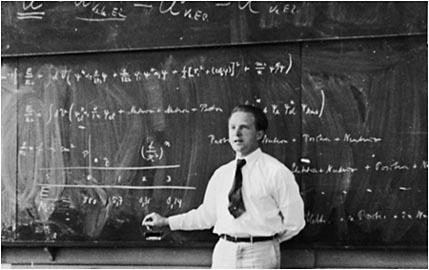
(Good ol' Heisenberg. SOURCE)

The uncertainty principle brings into question the role of the observer. The Copenhagen Interpretation is the standard interpretation of measurement, the "statistical nature of reality", and the philosophical debate over what effect an observer has over a system. It says that observation causes the wavefunction to collapse; also referred to as consciousness causes collapse. One of the more famous thought-experiments to demonstrate this sort of thing is the Schroedinger's Cat experiment. (In which no live cats were harmed, by the way. Just thought-experiment ones.)


But there are other ideas on how quantum mechanics works. There's the Many Worlds Theory, Consistent Histories, Ensemble Interpretation, de Broglie-Bohm Theory, Relational Quantum Mechanics, Transactional Interpretation, Stochastic Mechanics, Objective Collapse Theories, von Neumann/Wigner Interpretation, Many Minds, Quantum Logic, Modal Interpretations, Time-Symmetric Theories, the list goes on and on.

Obviously, there's a lot of figuring out to do.

*****

Sources:

*****

No question this time. You have the floor on quantum mechanics!


(Also, I won't be around to your blogs today. I'll do my best to catch up with posts tomorrow, and I'll be sure to swing by anyone who comments here.)

-----The Golden Eagle