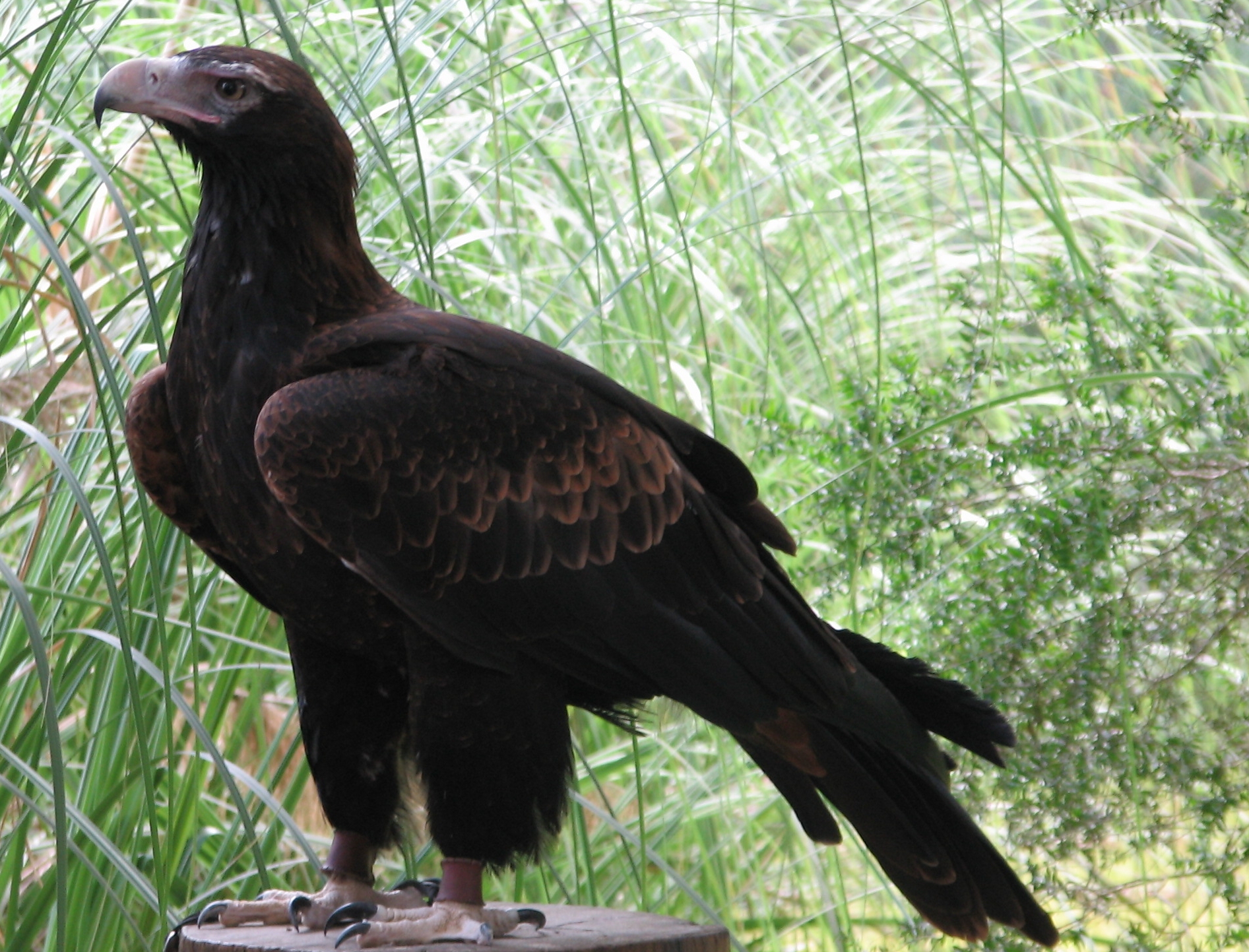
Showing posts with label Nature. Show all posts

04 April, 2013

A To Z Blogging Challenge: Dendrology And Dodder Vines

Dendrology is the study of woody plants and a subset of botany. The most familiar plants considered to be "woody" are trees, but dendrology includes vines and shrubs as well; not that trees exactly limit one's field of study since there are over 100,000 species in existence.

In the field of dendrology, it has been recently discovered that dodder vines (also known by some pretty colorful names including Witches' Shoelaces, Devil Guts, Hairweed, Love Vine, and Strangleweed), a parasitic plant that requires a host to survive, searches out its host by smelling for it. The dodder will move around in circles, detecting the chemical fingerprints of potential hosts, until it finds the right one and latches on.

The following video is a time lapse of a dodder's movements as it chooses between a wheat and a tomato plant; skip to 0:25 if you want to get straight to the action.


**********

Sources:
http://www.thefreedictionary.com/dendrology
http://www.tree-identification.com/dendrology.html
http://www.fcps.edu/islandcreekes/ecology/dodder.htm
http://www.npr.org/templates/story/story.php?storyId=6160709
http://phys.org/news78763233.html

**********

Ever heard of dodder vines before? (I hadn't until last night when I watched Nature.) Do you grow any vines or trees?


-----The Golden Eagle

28 May, 2011

I Caught A Toad (+ 2 Awards)

I did. With my bare hands and all that jazz.

Okay, first I put a flower pot over it, got my mom to show her, and then I picked it up and put it in the impromptu pond that formed in the neighbor's backyard because of all the pouring, drenching, incessant rain we've been having.

No, I don't have pics to prove it.

But I can show you want kind of toad it was:


Very toad-like, no? Warts and all.

*********

Anyway. Just a bit of odd stuff I wanted to post.

Now for the stuff you really want to know.

I was awarded by Canyon Girl at Desert Canyon Living:


Thank you so much, Canyon Girl!

. . . and I was also awarded either the Versatile Blogger Award or the Blog On Fire Award by Trisha at W O R D + S T U F F, and since I've never seen the latter before, I chose that one:


Thanks, Trisha! :)

And I award this one to:

Sarah at Glissades and Gabble (for cool posts--and an awesome title. I love dancing!)
Amanda the Aspiring at Truth, Justice, And Other Stuff (for excellent writing posts)
L. G. Smith at Bards and Prophets (for posts on everything including faint-worthy bookstores. I want to go to Buenos Aires. Like, immediately)
M Pax at Wistful Nebulae (for fascinating science information)
Karla at The Writing Pad (for great writing/life posts. And I adore the title of her blog, for some reason. Don't know exactly why.)
Jai Joshi at Jai Joshi's Tulsi Tree (for awesome vlog posts on the Mahabharat--I can say it right! I think--and her book)

I'm pretty sure I'm supposed to award 15 or something like that (isn't that usually the case?) but I'm just going to leave it here, okay? Good.

*********

Also, I wanted to thank all of those who did for commenting on my last post! I didn't expect to get 41 people to come by and respond--with pretty long responses, too! Awesome. I guess liking/not liking main characters in the books people read is more important than I had assumed.

*********

Hope you're all have a great Memorial Day Weekend! If you live in the USA. If you don't, I hope you're having a great non-holiday weekend!


-----The Golden Eagle

29 April, 2011

A-Z Blogging Challenge: Y Stands For: Yellowstone

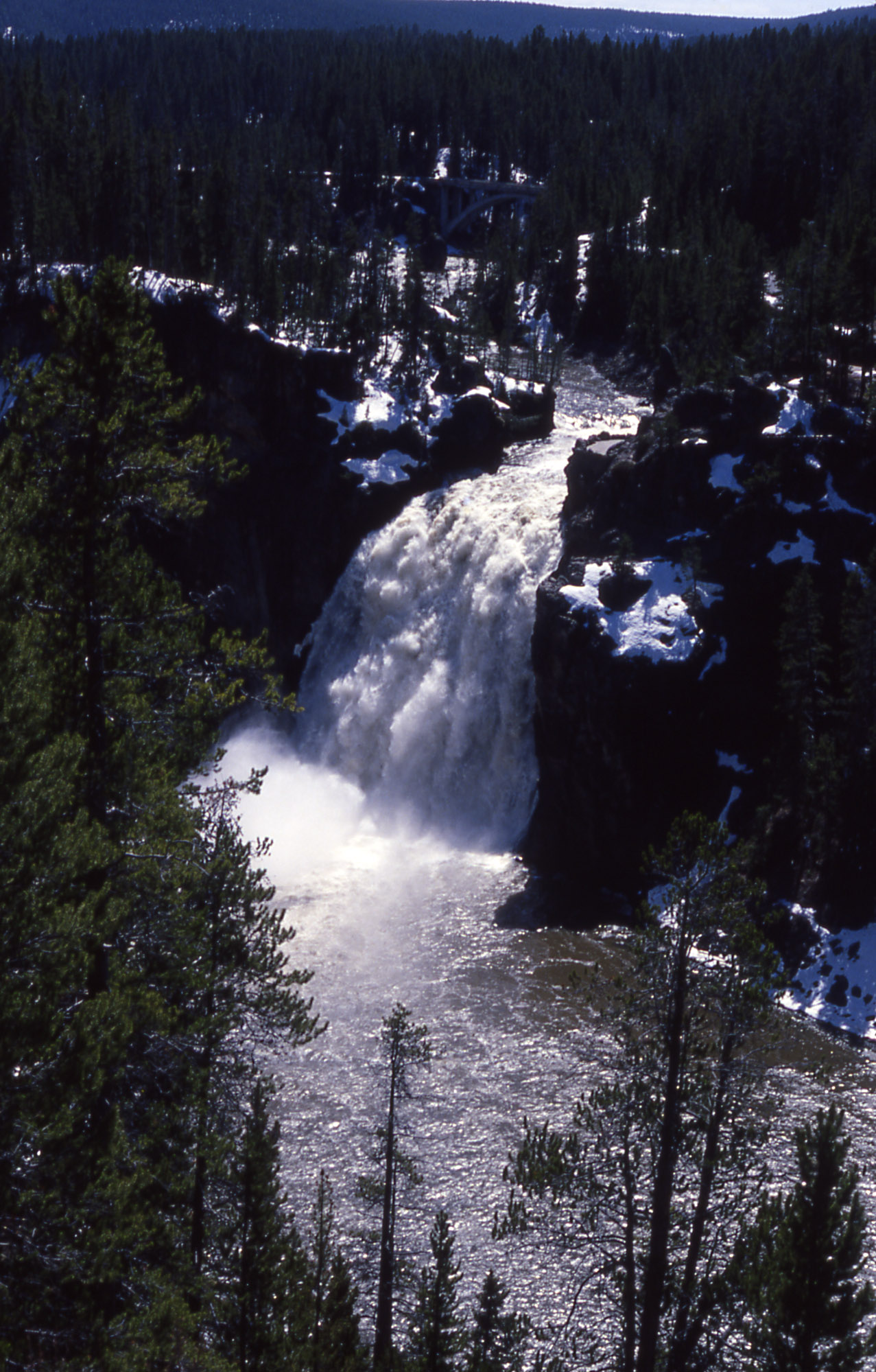
Yellowstone was the world's first national park. It was established in 1872, signed into law by Ulysses S. Grant on March 1st. It is a World Heritage Site and designated Biosphere Reserve, with 2.2 million acres, and covers parts of Wyoming, Montana, and Idaho.

(Yellowstone River, Upper Falls. SOURCE)

The name "Yellowstone" came from the Minnetaree (a Native American Indian tribe) word for a river with yellow sandstone bluffs: "Mi tsi a-da-zi". French trappers interpreted this as "Yellow Rock River", and called it "Pierre Jaune" or "Roche Jaune". Lewis and Clark came into contact with the same tribe, and also called it Yellow Rock River.

(Canada Lynx. SOURCE)

Yellowstone National Park is home to several threatened endangered species, including the Canada Lynx, the gray wolf, and the grizzly bear. Some other notable animals are the American bison, bighorn sheep, bobcats, coyotes, elk, moose, mountain lions, mule deer, to name the large ones. 67 mammal species live in the park (the largest concentration in the 48 states), 322 species of birds are recorded (148 of them nesting in the park), 16 species of fish (although 5 of them are non-native), 6 reptile species, and 4 species of amphibians. There are also 7 conifer species, 1,100 native species of plants, 199 non-native species of plants, 186 species of lichens, and 406 species of thermophiles.


The Yellowstone Caldera is the largest supervolcano in North America. It is indeed considered an active volcano, producing half the world's volcanic activity. The caldera has been measured at 55 km (34 miles) by 72 km (45 miles) in size, although a new survey has shown it could extend for up to 640 km (400 mi) east to west.


Three supereruptions have happened in Yellowstone's history--at 2.1 million, 1.3, and 640,000 years ago. The last time Yellowstone exploded, it sent 1,000 cubic km (240 cubic mi) of dust into the air, and if it was to erupt again (supervolcano eruptions are predicted to happen sometime in the future; in fact, we're overdue) it could bury North America in ash and disrupt life around the globe.


They say it won't be happening anytime soon. But, obvious in the recent catastrophes, the prediction of earthquakes, volcanoes, and other natural disasters is shaky at best.

*****

Source:
http://www.nps.gov/yell/index.htm
http://www.yellowstone-natl-park.com/history.html
http://www.nps.gov/yell/planyourvisit/factsheet.htm
http://en.wikipedia.org/wiki/Yellowstone
http://www.yellowstone-online.com/history/yhtwo2.html
http://www.visityellowstonepark.com/Park-Facts.aspx
http://www.nps.gov/yell/naturescience/mammals.htm
http://en.wikipedia.org/wiki/Animals_of_Yellowstone
http://www.nps.gov/yell/parkmgmt/bisoneiscon5.htm
http://www.livescience.com/200-super-volcano-challenge-civilization-geologists-warn.html
http://www.huffingtonpost.com/2011/04/13/yellowstone-supervolcano-2011_n_848681.html

*****

Do you think supervolcano eruptions are something we should be worried about? Do you think Yellowstone will erupt in the near future, or do you think this is just a bunch of pointless speculation?


Also, have you ever been to Yellowstone?


-----The Golden Eagle

26 April, 2011

A-Z Blogging Challenge: V Stands For: Vultures

Vultures, if you ask me, don't get enough respect.

(Ruppell's Griffon Vulture. SOURCE)

There are two kinds of vultures--Old World Vultures and New World Vultures, a total of 23 species. These two groups emerged through convergent evolution (when two separate populations acquire the same or similar traits), and are found on every continent except for Australia and Antarctica. Old World and New World aren't closely related, and they're only called vultures collectively because they occupy the same ecological niche.

(King Vulture. SOURCE)

Old World Vultures are part of the family Accipitridrae (which includes eagles, kites, buzzards, and hawks) and live in Africa, Asia, and Europe. These sorts of vultures find their food by sight only, and can see food up to 4 miles away.

New World Vultures, along with condors, live in the Americas. They belong to the family Cathartidae, which is part of the group of Accipitriformes. Several New World Vulture species have a good sense of smell and can scent their prey up to 1 mile.

(Egyptian Vulture. SOURCE)


The thing I don't get is why it's always the vulture who has the part of the bringer of death (and they don't actually hover over an animal that's about to die, though they will kill the sick and weak who would die anyway), symbolizes approaching doom, represents evil, shrieks and screams at the good guys, and all that other very charismatic stuff.

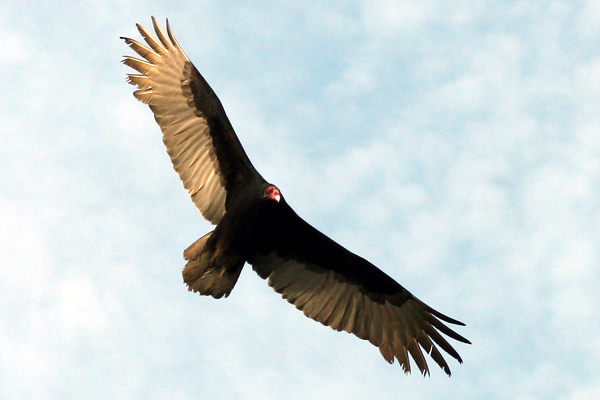
(Turkey Vulture. SOURCE)

So they eat dead things. Heck, they're not the only creatures in the animal kingdom who eat food that's been sitting around for a while. Scavengers actually help clean up the planet--without them, carcasses and bodies would simply hang around to rot and decay. But when it's eaten by something like a vulture, that problem is eliminated and all that's left are bone fragments and maybe a few scraps for other scavengers to pick up. Animals fed, body gone.

Isn't that a good thing?


*****

Sources:
http://en.wikipedia.org/wiki/Vulture
http://animal.discovery.com/birds/vulture/
http://ecolocalizer.com/2009/09/05/16-cool-facts-about-vultures-on-international-vulture-awareness-day/

And if you'd like to learn about International Vulture Awareness Day, go HERE.

*****

So, what do you think of vultures? Love or hate? Pests, or helpful cleanup crew?


-----The Golden Eagle

12 April, 2011

A-Z Blogging Challenge: J Stands For: Jellyfish


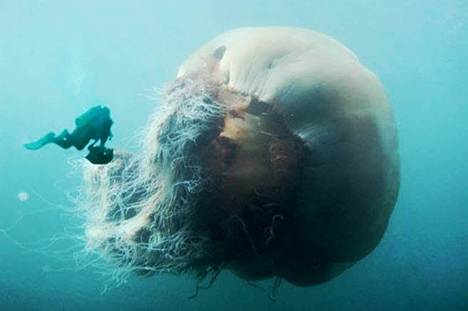
Jellyfish are members of the phylum Cnidaria (also known as Coelenterate), which is the same phylum as coral. They aren't actually fish--they are invertebrates. The term jellyfish can also refer to the phylum Ctenophora, of whose members are not closely related to Cnidaria but are also free-swimming planktonic carnivores.


Jellyfish do not have brains or eyes or bones, and nor do they have specialized digestive, respiratory, or circulatory systems like so many other animals.


Instead, they digest by absorbing nutrients in their gastrovascular cavity through the gastrodermal lining. They move by using their hydrostatic skeleton, in contractions and pulses. Jellyfish also have small sacs located at the rim of their bell-shape that sense in what direction the animal is traveling: they trigger nervous reactions when the jellyfish is heading too far in one direction. Humans have similar sacs in their ears.


They are more than 90% water. Most of their mass is the mesoglea, the jelly part, surrounded by two layers of epithelial cells. The epidermis is the external body surface, and the gastrodermis is the internal surface.


A jellyfish's "nerve net" is a network of nerves located in the epidermis. The nerve net is used to detect stimuli, such as the touch of another animal; impulses are sent through the nerve net, around a circular nerve ring, through the rhopalial lappet (rhopalium are "small sensory structures"), and then to other nerve cells throughout the body. Jellyfish also have ocelli, which are light-sensitive cells that can detect whether the animal  is swimming up or down.


*****

Sources:
http://en.wikipedia.org/wiki/Rhopalium
http://www.answersingenesis.org/creation/v25/i4/nobrain.asp
http://www.dnr.sc.gov/marine/pub/seascience/jellyfi.html
http://en.wikipedia.org/wiki/Jellyfish

*****

Have you ever seen--or been stung by--a jellyfish?


Also, as some of you may have noticed, I changed the layout of my blog from a three-column to a two-column and adjusted some of the fonts/colors. What do you think?


-----The Golden Eagle
Enhanced by Zemanta

06 April, 2011

A-Z Blogging Challenge: E Stands For: Eagles

How could I resist?

The Golden Eagle Aquila chrysaetos is one of t...Image via Wikipedia

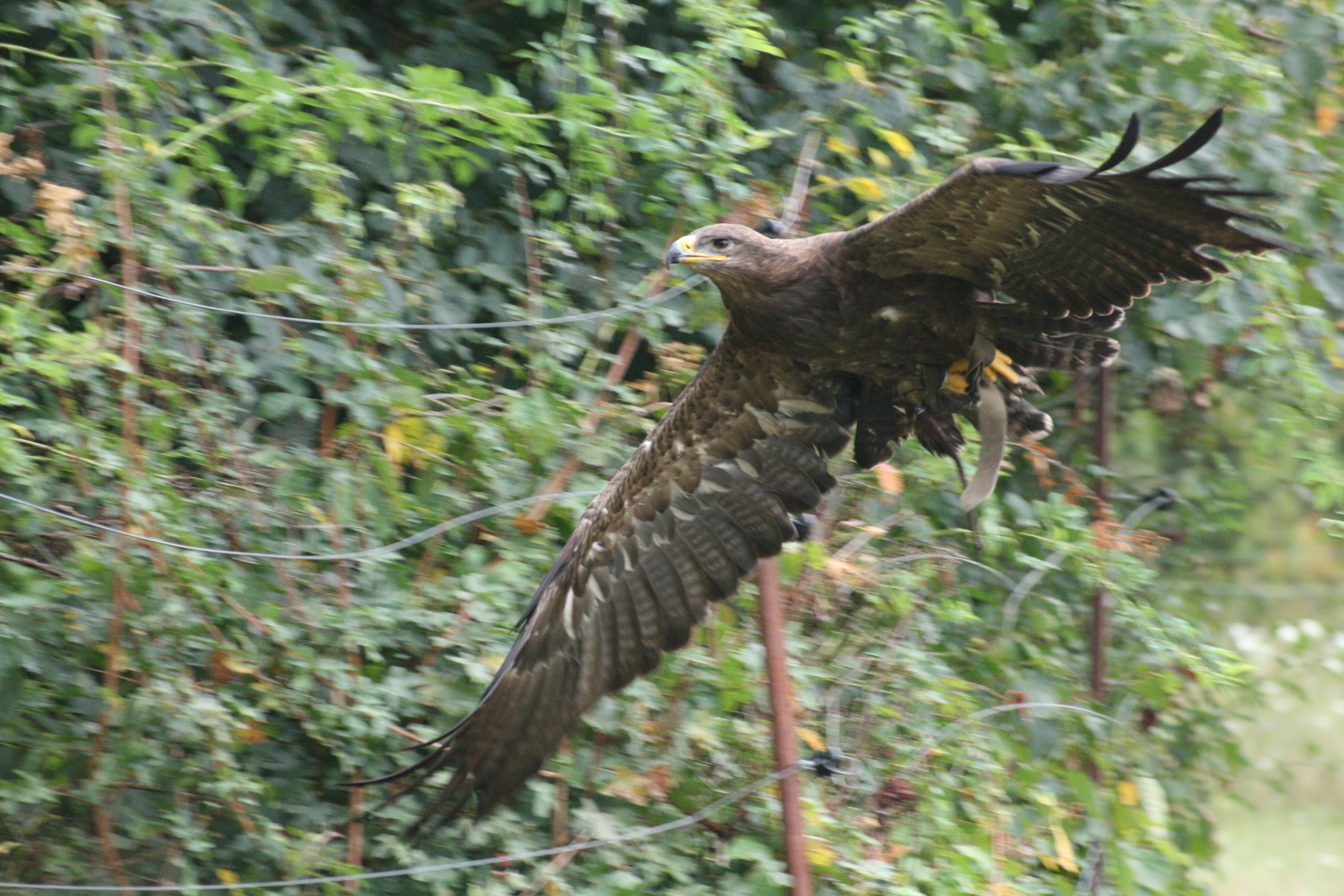
Eagles are part of the bird family Accipitridae, and there are over 60 different species of eagle. The word "eagle" is derived from the Latin word "aquila", which may come from the word meaning dark-colored, swarthy, or blackish, referring to the eagle's feathers.

The Golden Eagle, or Aquila Chrysaetos (trust me, I never considered going around with the name Aquila chrysaetos) lives across North America, Eurasia, and parts of Africa, with its densest nesting populating living in Alameda County, California. Its size ranges from 70 to 85 cm/2 ft 4 in to 2ft 9 in in length, and the wingspan is 185 to 220 cm/6 ft 1 in to 7 ft 3 in. The species was first described in 1758 by Linnaeus. It is part of a worldwide superspecies with Verreaux's Eagle, Gurney's Eagle, and the Wedge-Tailed Eagle.


The Bald Eagle, the national bird of the USA, is a kind of sea eagle. It lives across the entire United States (in theory--people have driven them out in a lot of areas thanks to habitat destruction and so forth), parts of Canada and Alaska, and in northern Mexico. It was put on the list of threatened species on July 12, 1995 thanks to a dramatic drop in population numbers, but was then removed from it on June 28, 2007. (Hooray!)


Technical details aside, I love these birds because they're beautiful creatures. It's amazing to watch any bird fly--but I find something special about eagles. Their grace in the air, the way they dive, their proud, noble expressions. They're just amazing birds.


*****

*sighs happily*


Sources:

http://en.wikipedia.org/wiki/Eagle
http://en.wikipedia.org/wiki/Bald_Eagle

Do you have a favorite eagle? Is there a kind of animal that you love?


-----The Golden Eagle
Enhanced by Zemanta

07 December, 2010

The Answer! (Plus: Award, and Other Miscellany)

The moment has arrived! I shall now reveal who exactly the kind of person it is in the Through the Keyhole Blogfest entry I posted on Monday.

First off, most of you who guessed said that you thought it was a male widow.

Partly right, although not completely. I wasn't aiming for anything so tragic.

He--and yes, it is a he, you were right on the gender!--is a traveling writer, doing research for his book, going to conventions/meetings, and the computer is what he writes on; the CD-RW has his files burned onto it. The green string is indeed a luggage tag, a remnant of his last trip to the airport. The picture of the couple is an image of him and his wife, but they're not divorced/separated, and there's no sorrowful backstory--he's just traveling abroad, while his wife stays home. They're a happy couple. :) The picture is a reminder . . .

*****

Now, L'Aussie awarded me the Fair Dinkum Award.


So, I'd like to give L'Aussie a big THANK YOU! and  *hug* for awarding me. :) It is much appreciated!

Me being American, I'd never heard of a Fair Dinkum before--L'Aussie apparently anticipated that, and told the award-ees to guess what they thought a Fair Dinkum was. (Read my comment HERE.) Hopefully, I got it at least somewhat right. :P

I also get to pass it on, too, and here are the people I'm awarding next with the Fair Dinkum Award (trying to be sure that no one's nabbed 'em before me . . . LOL):

Robyn Campbell
Brian
Sangu Mandanna
Madeleine
Dominic de Mattos

. . . and there are many others out there--Blogger seems to be a Fair Dinkum melting pot!

*****

Have you heard that the US Department of the Interior wants to strip Northern Rocky Mountain wolves of their Endangered Species status?

Now, look: I have absolutely nothing against saying that they're not on the brink of extinction. Hooray for that, actually. But LET'S NOT HUNT THE WOLVES. Please. If they're going to take wolves off the list, DON'T let them be hunted back onto it!

Remember what happened last time the wolves were killed, and there weren't enough of them out there? The ecosystem collapsed. Deer populations, (which are still issues in some parts of the country) went wild, eating, then starving themselves out as they ate everything, killing their food supplies due to lack of control by predators. We NEED the predators!

*****

You know that site that's been circulating for the past few days, every since Jen posted that awesome interview with Miranda Dickinson? Authonomy.com, set up by Harper Collins? It sound like an awesome site, and a good opportunity for getting your work out there. Publishers, agents, and other people like that will be able to read it, and you get exposure. People get to read your books and comment on them. Publishers have actually published works by the authors there.

Well, apparently you can't use it unless you're over 18.

*sigh* I don't happen to be over 18, which means that option's out the window. What's with the rule, anyway? Doesn't make sense to me.

*****

You may have noticed that I took down the Other Blogs page I had up, with all you bloggers' buttons. I don't hate your buttons--in fact, many of them are quite nice, and I make those kind of images myself--but the format was acting up giving me tons of white space, and it's easier to just add people to the blogroll on my sidebar. So, if you were on the Other Blogs page, rest assured that you are on the blogroll. :)

(I might set up one of the moving, repeating sequences of buttons, if I can figure out how . . . or I may just put up the page again in the future.)

*****

It snowed ALL DAY yesterday. Non-stop. There are several inches on the ground right now, and it's supposed to snow more this week--hooray! Not that I get snow days, being homeschooled and all . . . but it's the symbolic aspect. Plus, I love snow.


-----The Golden Eagle

31 October, 2010

Happy Halloween! (Plus: NaBloWriMo, NaNoWriMo, And Random)

HAPPY HALLOWEEN! Hallowe'en. All Hallows Eve. Whatever you'd like to call it, today's the day! Have fun trick-or-treating, partying, whatever. :)


*****

Today is also the last day of NaBloWriMo! I have posted at least once every day for the entire month of October! Even more reason to celebrate.

But, if you're like me and have participated in NaBloWriMo, don't do party too hard! Because tomorrow is *drumroll*dramatic display* NaNoWriMo!


I know that I've said several times that I wasn't planning on doing this event. For many reasons, I told myself. It wouldn't be good for my novel, I said. It would be better to edit, I thought. I don't think word-vomiting all over my document would be a really great idea, I consoled myself.

*sighs* EXCUSES. But you know what? I've decided to change that. Because of a lot of factors. So, basically, I am going to be doing NaNoWriMo!


(If you don't know what NaNoWriMo is by now, I'm seriously going to question where you've been for the past month.)

I'm kind of pushing the deadline to sign up here, but I did sign up to do it! This will be my first year. But hey, I wrote 40,000 words last month, so it's just 10,000 more than that. So, the thing on my mind right now is, I am going to kill this challenge with everything I've got.

Here's the link to My Profile. Buddy me, if you've got an account. (I can't find a lot of you, because there's no "search" for the profiles or anything like that.) At first I wasn't sure about linking to it, but I managed to disable the Home Region thing, which would basically tell you where I live. Boo. I didn't want to do that.

I'll update you guys over there and on this blog with one of those word count widget-y things. I think I'll use the potato man one:


Anywho. Just get geared up for the absolute writing frenzy--it's 50,000 words, after all!

*****

Interesting, because they don't come around here often, but I saw a bald eagle yesterday! Just perched. It was sort of far away, but I could see the characteristic white head and dark brown body. It would be nice if it stuck around . . . but I doubt that.

Ever seen one?


It was snowing a few days ago. SNOWING. It just wet the sidewalk a little, but it's c-c-c-o-o-l-d-e-r than usual now. Even for the beginning of November, people are not usually shivering in a winter coat. It's supposed to get colder and stay that way for a while, too.


Have a great Halloween, all!


-----The Golden Eagle

06 September, 2010

It Would Be A Stretch to Call Them Beautiful . . .

The California Condor is one of North America'...Image via Wikipedia

But it wouldn't be fair to call them totally ugly.

They may not be the prettiest creatures in the animal kingdom . . .

But they do us a service.

They may not look the nicest, or sound the greatest . . .

But they're definitely fascinating.

Their appearances are dark and moody . . .

But that doesn't mean they're cruel.

They may not eat what's considered delicate fare . . .

But at least someone's eating it.

I'm talking about . . .


The Californian Condor, or Gymnogyps Californianus.

The bird that was on the verge of extinction in 1987, with only 22 left, due to poaching, habitat destruction, and poisoning. The few that remained alive were captured and bred in the Sand Diego Wild Animal Park and the Los Angeles Zoo.

Until, in 1991, the numbers were up sufficiently to return the condors to the wild.

Currently, there are only 384 known, only 188 of those living out of captivity.

A real Condor moment...Image by law_keven via Flickr

Did you know that their heads change color depending on their emotions?

A Californian Condor in flight, photographed f...Image via Wikipedia


Did you know that their wingspan is almost 10 feet?


Did you know that they're mostly mistaken as small, far-off airplanes, as opposed to another species of bird?


Did you know that contrary to a lot of birds, the male is actually bigger than the female?


Did you know that they live in oakland savannas, coniferous forests, and scrubland?

I don't see why so many people don't like scavengers and carrion-eating birds such as the condor. Yes, they search for corpses.

But they don't actively fly over animals they think are going to die.

Yes, they stick their heads in those corpses.

But that's why they're bald.

Yes, they swallow bones and pick off of someone else's meal.

But they don't actually kill their food to get it.

And would we prefer it if the dead animals just stayed there to rot and decay, either by the side of the road or wherever the animal was killed? Isn't having someone benefit off of those bones and meat a good thing?


Love the condors, people. They're cool birds.

-----The (condor-appreciating) Golden Eagle
Enhanced by Zemanta

25 August, 2010

The Four Winged Dinosaur

Microraptor is one cool . . . dinosaur-slash-bird. I mean, there aren't any animals with wings on their hinds legs and certainly not ones that glide like flying squirrels. And they don't look like anything from our time, either, with a dinosaur-like beak, a long tail, and four wings.

Dinosaurs are not what you usually think of when you think of the origin of birds. They don't really look like birds in, say, Jurassic Park or in the typical T. Rex image, but dinosaurs did have feathers. And now there's evidence that Microraptor may just have been the divergent point in evolution where dinosaurs and birds branched off. Unless, of course, an earlier fossil with wings appears somewhere around the world . . .


Watch the full episode. See more NOVA.


If that doesn't load, go HERE. Pretty cool animal, eh?

Another hit for NOVA. :)

(Hmmm. Think I should change my name to "The Golden Microraptor"? JK. I like eagles just fine.)

-----The Golden Eagle