Showing posts with label Light. Show all posts

03 April, 2013

A To Z Blogging Challenge: Cosmology And Cosmic Microwave Background Radiation (+ IWSG)

Cosmology is the study of the universe as a whole: It's origin, its current state, and its future. Cosmology differs from astrophysics in that the latter is more focused on moons, planets, galaxies, stars, and other intergalactic forces, though there is significant overlap between the two fields; many scientific discoveries in one area of study affect the other.

One recent development in cosmology has been a better, much more detailed image of the universe's cosmic microwave background radiation, or CMBR, taken by the European Space Agency's Planck satellite. CMBR is considered to be a significant piece of evidence that the Big Bang (an extremely rapid explosion some 12-15 billion years ago considered by many cosmologists to have created the universe) actually happened. Assuming the Big Bang Theory is accurate, it calls for photon radiation (light) just after the initial explosion; these photons have since extended their wavelengths to become microwaves, hence the name cosmic microwave background radiation.

The radiation pattern shows fluctuations that, in some of the earliest moments of the Big Bang, caused the formation of galaxies and the other objects in the universe. It also supports the idea that the universe expanded very, very rapidly just after the Big Bang, and then slowed down, which would explain the size of the universe. The initial rapid expansion is called inflation.

**********

Sources:
http://www.thefreedictionary.com/cosmology
http://map.gsfc.nasa.gov/universe/
http://abyss.uoregon.edu/~js/cosmo/lectures/lec23.html
http://www.superstringtheory.com/cosmo/
http://www.newscientist.com/topic/cosmology
http://dawn.com/2013/04/03/plank-probes-map-a-picture-of-our-universe/
http://www.esa.int/Our_Activities/Space_Science/Planck/Planck_reveals_an_almost_perfect_Universe
http://science.nasa.gov/astrophysics/focus-areas/what-powered-the-big-bang/

**********

And now, for the IWSG part of my post. In case you don't know what the Insecure Writer's Support Group is, check out this page on Alex J. Cavanaugh's blog.

My insecurity today is letting my writing sit for long periods of time; I haven't worked on my novel (my as-yet-unfinished NaNoWriMo novel, just to give you an idea for how long it's been around) in almost a month, and that's not unusual for me. A lot of people would argue you're supposed to write every day, even if it's just a few words, so my question is: Have you tried writing every day? Did it work? Were you more productive in the long term, or do you prefer to write in spurts?


Do you think cosmologists will someday be able to pinpoint the origin and the future of the universe? 


-----The Golden Eagle

26 April, 2012

A-Z Blogging Challenge: Wave-Particle Duality

Example of a double slit experiment, by Timm Weitkamp,
CC-BY-3.0-de. SOURCE.
Wave-particle duality is a principle of quantum physics that says matter and light act as both waves and particles, and that the observed behavior depends on the experiment.

Since the 1600s, scientists tried to figure out whether light, a type of electromagnetic radiation, came in waves or was made up of particles. Christiaan Huygens developed a wave theory (also suggesting that there was a luminiferous ether through which waves traveled, since it was generally thought waves needed a medium) and Isaac Newton a particle (or corpuscular) theory. It wasn't until the 1800s with Thomas Young's double-slit experiment and the buildup of other evidence pointing toward the fact light acted like a wave that Newton's theory was overturned. At least until the Michelson-Morley Experiment, which tried and failed to find any ether.

There are six major types of light phenomenon: reflection, refraction, interference, diffraction, polarization, and the photoelectric effect, all of which can be explained by wave theory, except for the photoelectric effect. Then Albert Einstein published a paper that explained it (introducing photons as continuous waves in 1905), wave-particle duality was also proved to take place with matter by Louis de Broglie (who was awarded the Novel Prize in 1929), and Niels Bohr proposed that light could take on either wave or particle characteristics. Hence, with no other explanation, duality was accepted as reality.

Example of an interference pattern, by Thierry Dugnolle,
public domain image. SOURCE.
One of the more famous experiments done which helped prove wave-particle duality was Young's Double Slit Experiment. To take Richard Feynman's analogy, imagine someone shooting at a wall through two slits in a sheet of metal. You would expect the bullets to be centered close to two narrow bands on the far wall--but with light, that isn't true. Instead (to stretch the example a bit far) the pattern of bullets would show up as an interference pattern (bright and dark bands, in the case of light; see above image) as though projectiles were passing through the slits at the same time and bouncing off each other.

No notable scientist today. Quantum physics is far from stagnant, of course, but I don't know of any wave-particle dualicists. But if you'd like a simulated ripple tank to play around with that has an example of the double-slit experiment (just make sure you have Java):

http://www.falstad.com/ripple/ex-2slit.html

**********

Sources:
http://www.britannica.com/EBchecked/topic/637889/wave-particle-duality
http://www.colorado.edu/physics/2000/schroedinger/two-slit3.html
http://hyperphysics.phy-astr.gsu.edu/hbase/mod1.html
http://library.thinkquest.org/28383/nowe_teksty/htmla/2_10a.html
http://micro.magnet.fsu.edu/primer/java/interference/doubleslit/
http://physics.about.com/od/lightoptics/a/doubleslit.htm
http://physics.about.com/od/lightoptics/a/waveparticle.htm
http://science.howstuffworks.com/light6.htm
http://www.supraconductivite.fr/en/index.php?p=supra-quantique-dual
http://www.thefreedictionary.com/wave-particle+duality
http://www.upscale.utoronto.ca/PVB/Harrison/DoubleSlit/DoubleSlit.html

**********

Do you think any other strange properties such as wave-particle duality will be discovered?


-----The Golden Eagle

21 April, 2012

A-Z Blogging Challenge: Spectroscopy

A more dramatic example of visible flame spectroscopy, by Arthur Jan
Fijalkowski, CC-BY-SA-3.0. SOURCE.
Spectroscopy (also called spectrography) is the study of spectra.

In the physics sense, spectra (the plural of spectrum) are energy emitted in the form of different wavelengths, such as electromagnetic radiation, which includes gamma rays, x-rays, ultraviolet, visible light, infrared, microwaves, and radio waves. Spectroscopy is used to determine the composition and the movement of matter, based on how it reacts to radiation.

Part of spectroscopy focuses on visible light and its colors, though there is also--and to name just a few of the many different kinds of spectroscopy--atomic absorption spectroscopy (the study of how energy is absorbed using radiation), electron paramagnetic spectroscopy (which uses microwaves), electron spectroscopy (measures changes in electron energy levels), Fourier transform spectroscopy (matter is bombarded with radiation and the results analyzed with mathematics), gamma-ray spectroscopy, infrared spectroscopy, mass spectrometry (generates ions that interact with the matter in question), Mossbauer spectroscopy (used in mineralogy to detect iron), Raman spectroscopy (uses the scattering of light to find the vibration and rotation of molecules), and x-ray spectroscopy.

For more detail about how spectroscopy actually works, let's take the example of light. Light spectroscopy examines continuous and discrete spectra: A continuous spectrum includes a range of colors with few interruptions along the observed wavelengths, while a discrete spectrum has dark-light contrast between wavelengths.

Specific elements can be determined using spectroscopy because when an atom absorbs energy its electrons move into a higher orbit, and when the electrons fall back to a lower orbit, energy is released in the form of a certain wavelength of radiation. With discrete spectra, brighter colors are emission spectra and darker spikes are absorption spectra, and these fluctuations are characteristic to certain atoms and molecules. This use of spectroscopy is particularly important in astronomy, and the matter, temperature, density, and motion of objects in space can be discerned from those observed changes.

An example of magnetic resonance spectroscopy (MRS).
© Nevit Dilmen, CC-BY-SA-3.0. SOURCE.
Notable Spectroscopist:

Joseph P. Hornak

Joseph Hornak is a Professor of Chemistry, Materials Science and Engineering, and Imaging Science at the, and the Director of the Magnetic Resonance Laboratory at the Rochester Institute of Technology (RIT), as well as an Adjunct Associate Professor of Radiology at the University of Rochester. He graduated with a Ph.D. in Chemistry from Notre Dame University and is a Fellow of the American Chemical Society, International Society of Magnetic Resonance, and the Environmental and Engineering Geophysical Society.

His research at RIT involves magnetic resonance imaging (MRI) and magnetic resonance spectroscopy.

**********

Sources:
http://chemistry.about.com/od/analyticalchemistry/a/spectroscopy.htm
http://www.cis.rit.edu/people/faculty/hornak/
http://coolcosmos.ipac.caltech.edu/cosmic_classroom/ir_tutorial/spec.html
http://imagine.gsfc.nasa.gov/docs/teachers/hera/spectroscopy/what_is_spectroscopy.html
http://kicp-yerkes.uchicago.edu/2004-summer/pdf/ysi2004-spectroscopy.pdf
http://www.news-medical.net/health/Spectroscopy-Types.aspx
http://www.news-medical.net/health/Spectroscopy-What-is-Spectroscopy.aspx
http://serc.carleton.edu/research_education/geochemsheets/techniques/mossbauer.html
http://www.thefreedictionary.com/spectrum
http://www.thefreedictionary.com/spectroscopy
http://www.wisegeek.com/what-is-spectroscopy.htm
http://www3.wooster.edu/chemistry/is/brubaker/intro_spectroscopy.html

**********

Think you'd ever want to be a spectroscopist? (I actually found job listings, which I've never come across for any other scientific field I researched.)


-----The Golden Eagle

14 April, 2011

A-Z Blogging Challenge: L Stands For: Laser

Laser is an acronym for Light Amplification by Stimulated Emission of Radiation. It has been noted, however, that the acronym "Loser" for Light Oscillation by Stimulated Emission of Radiation would be more accurate.

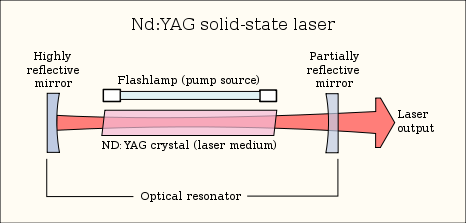
A laser is constructed from an energy source, a gain medium, and two mirrors.


Some of the most common sources of energy for a laser, called the pump source, are flash lamps, arc lamps, and external lasers, but microwaves, radiofrequency radiation, the sun, electric glow discharge (a type of plasma), electron beams, the supersonic flow of gases such as CO2, chemical reactions, and nuclear fission have also been used.


There are thousands of different gain media, which is also known as laser media. Liquids such as organic chemical solvents combined with chemical dyes, gases such as carbon dioxide, argon, krypton, and mixtures of helium-neon, and solids such as crystals and glasses with added impurities, are some examples.


The optical resonator, also called the optical cavity, in its simplest form is made of two parallel mirrors surrounding the gain medium. One is a high reflector and one is a partial reflector.

When light is spontaneously emitted from the medium, it is reflected by the mirrors back into the medium and then amplified by stimulated emission. Stimulated emission is when an atom interacts with a wave of a certain electromagnetic frequency, drops to a lower energy level, and emits a photon.

The emitted photons are what you see as a beam of light.


In 1960, lasers were called a "solution looking for a problem". Nowadays, they have widespread uses in electronics, information technology, science, medicine, industry, law enforcement, military, and entertainment.

*****

Sources:
http://en.wikipedia.org/wiki/Laser
http://en.wikipedia.org/wiki/Laser_construction
http://en.wikipedia.org/wiki/Laser_pumping
http://en.wikipedia.org/wiki/Electric_glow_discharge
http://en.wikipedia.org/wiki/Stimulated_emission
http://science.howstuffworks.com/laser.htm

*****

How do you see the future of lasers? Do you think they'll continue being important in technology, or that they'll become obsolete with another discovery?


Also, while it's not particularly earth-shattering, I rewrote the "About This Blog" page. I felt like it needed a serious change . . . and if you're interested, you can go HERE to read the new one.


-----The Golden Eagle
Enhanced by Zemanta