Showing posts with label Scientific Theories. Show all posts

26 April, 2012

A-Z Blogging Challenge: Wave-Particle Duality

Example of a double slit experiment, by Timm Weitkamp,
CC-BY-3.0-de. SOURCE.
Wave-particle duality is a principle of quantum physics that says matter and light act as both waves and particles, and that the observed behavior depends on the experiment.

Since the 1600s, scientists tried to figure out whether light, a type of electromagnetic radiation, came in waves or was made up of particles. Christiaan Huygens developed a wave theory (also suggesting that there was a luminiferous ether through which waves traveled, since it was generally thought waves needed a medium) and Isaac Newton a particle (or corpuscular) theory. It wasn't until the 1800s with Thomas Young's double-slit experiment and the buildup of other evidence pointing toward the fact light acted like a wave that Newton's theory was overturned. At least until the Michelson-Morley Experiment, which tried and failed to find any ether.

There are six major types of light phenomenon: reflection, refraction, interference, diffraction, polarization, and the photoelectric effect, all of which can be explained by wave theory, except for the photoelectric effect. Then Albert Einstein published a paper that explained it (introducing photons as continuous waves in 1905), wave-particle duality was also proved to take place with matter by Louis de Broglie (who was awarded the Novel Prize in 1929), and Niels Bohr proposed that light could take on either wave or particle characteristics. Hence, with no other explanation, duality was accepted as reality.

Example of an interference pattern, by Thierry Dugnolle,
public domain image. SOURCE.
One of the more famous experiments done which helped prove wave-particle duality was Young's Double Slit Experiment. To take Richard Feynman's analogy, imagine someone shooting at a wall through two slits in a sheet of metal. You would expect the bullets to be centered close to two narrow bands on the far wall--but with light, that isn't true. Instead (to stretch the example a bit far) the pattern of bullets would show up as an interference pattern (bright and dark bands, in the case of light; see above image) as though projectiles were passing through the slits at the same time and bouncing off each other.

No notable scientist today. Quantum physics is far from stagnant, of course, but I don't know of any wave-particle dualicists. But if you'd like a simulated ripple tank to play around with that has an example of the double-slit experiment (just make sure you have Java):

http://www.falstad.com/ripple/ex-2slit.html

**********

Sources:
http://www.britannica.com/EBchecked/topic/637889/wave-particle-duality
http://www.colorado.edu/physics/2000/schroedinger/two-slit3.html
http://hyperphysics.phy-astr.gsu.edu/hbase/mod1.html
http://library.thinkquest.org/28383/nowe_teksty/htmla/2_10a.html
http://micro.magnet.fsu.edu/primer/java/interference/doubleslit/
http://physics.about.com/od/lightoptics/a/doubleslit.htm
http://physics.about.com/od/lightoptics/a/waveparticle.htm
http://science.howstuffworks.com/light6.htm
http://www.supraconductivite.fr/en/index.php?p=supra-quantique-dual
http://www.thefreedictionary.com/wave-particle+duality
http://www.upscale.utoronto.ca/PVB/Harrison/DoubleSlit/DoubleSlit.html

**********

Do you think any other strange properties such as wave-particle duality will be discovered?


-----The Golden Eagle

24 April, 2012

A-Z Blogging Challenge: Unified Theory

Hubble Ultra Deep Field. Public domain image. SOURCE.
The Unified Theory of physics, also known as the Grand Unified Theory (GUT) or Theory of Everything (TOE), is a yet-to-be-found theory that would bring together the strong force, weak force, electromagnetic force, and gravity into a single theory.

The history of the search for a unified theory started with James Maxwell, who from 1861-65 demonstrated that electricity and magnetic fields were related, in his theory of electromagnetism. Then, in 1881-84, Heinreich Hertz discovered light and radio waves were also examples of electromagnetism. Albert Einstein tried for 30 years but could not find a theory that united the remaining forces.

There have been several theories proposed as solutions to GUT. One is supersymmetry (it proposes that all matter has a massive "shadow" force carrier), and another string theory (the idea there are more than three dimensions and that particles consist of strings and membranes), but there is no theory that has been broadly accepted.


And today there are three Notable scientists who have worked on unified field-related research. Three, because I was having trouble narrowing it down to one (links will take you to past A-Z Challenge posts on this blog, with the info about the scientists at the bottom):


**********

Sources:
http://www.britannica.com/EBchecked/topic/614522/unified-field-theory
http://dictionary.reference.com/browse/unified+field+theory
http://www.grandunifiedtheory.co.uk/
http://www.livescience.com/9513-greatest-mysteries-theory.html
http://www.particleadventure.org/grand.html
http://www.pbs.org/wgbh/nova/physics/theory-of-everything.html
http://pdg.web.cern.ch/pdg/cpep/unified.html
http://physics.about.com/od/quantumphysics/f/uft.htm
http://searchcio-midmarket.techtarget.com/definition/unified-field-theory
http://www.thefreedictionary.com/grand+unified+theory

**********

If a unified theory is found, what kind of effect do you think it will have on physics? On other fields?


-----The Golden Eagle

19 April, 2011

A-Z Blogging Challenge: P Stands For: Particle Physics

Particle physics is a branch of physics that studies the elementary particles of matter and radiation. An elementary, also called fundamental, particle is something that has no substructure--it is not made up of smaller particles. Particle physics is also referred to as high energy physics, because fundamental particles can only be created in particle accelerators.


The classification of all those particles comes together in the Standard Model. The Standard Model has only twelve basic particles, which are governed by four forces.

The twelve matter particles are quarks and leptons. Each of these two groups has "generations"--the first generation being lighter and more stable, while the second and third are heavier and less stable. All the stable matter in the universe belongs to the first generation, because the particles that make up the second and third decay to a more stable level.


There are up quarks, down quarks, charm quarks, strange quarks, top quarks, and bottom quarks, to cover the first six out of the twelve. Then there are electrons, electron-neutrinos, muons, muon-neutrinos, taus, and tau-neutrinos.


Three of the four fundamental forces--the strong force, the weak force, the electromagnetic force, and the gravitational force--result because of the exchange of "force carrier particles", called bosons. Fundamental particles exchange these bosons and, therefore, discrete amounts of energy. The strong force is carried by the gluon, the weak force by the W and Z bosons, the electromagnetic force by the photon, and the graviton for the gravitational force has not been found yet.


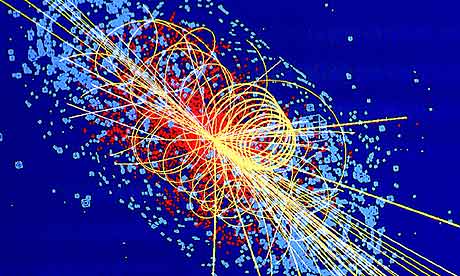
And last but not least, there's the Higgs Boson, which is thought to be the reason other particles have mass. The boson is predicted to exist because of the Standard Model, which incorporates it to solve problems with current theoretical physics. Experiments are being done to prove its existence with the Large Hadron Collider at CERN and Tevatron at Fermilab (although the latter will cease operations in September), but it has yet to be observed.


*****

A very cool video on the Standard Model (the scientists probably explain things way better than I do):


Sources:
http://public.web.cern.ch/public/en/science/StandardModel-en.html
http://en.wikipedia.org/wiki/Standard_model
http://particleadventure.org/index.html
http://en.wikipedia.org/wiki/Elementary_particle
http://en.wikipedia.org/wiki/Particle_physics
http://en.wikipedia.org/wiki/Higgs_boson
http://en.wikipedia.org/wiki/Tevatron
http://www.universetoday.com/26829/fermilab-putting-the-squeeze-on-higgs-boson/

*****

What do you think of particle physics? Do you think the Higgs boson will be found soon? Do you think the Standard Model, despite the fact it omits gravity from the calculations, will continue to be the way scientists describe fundamental particles?


-----The Golden Eagle
Enhanced by Zemanta

05 April, 2011

A-Z Blogging Challenge: D Stands For: Dark Matter

Scientists know little about dark matter.

Even though they think it makes up 23% of the universe, and 80% of all matter, dark matter is not detectable along the electromagnetic spectrum (i.e. radio, microwave, infrared light, visible light, ultraviolet, x-ray). A few of the only signs of dark matter are temperature distribution in hot gas, the rotational speeds of galaxies (stars revolve around the center of their galaxies), and gravitation lensing (which is when light curves around an object to reach whatever's observing it).


These effects are attributed to dark matter because there is no clear way of explaining them without it. If dark matter really is playing a part in the universe, then it would explain the so-called "missing mass" and the current laws of physics would still work.

A video on dark matter:


Watch the full episode. See more NOVA scienceNOW.

*****

Although, dark matter is only one theory. It's obvious something is interfering with the way the universe should (according to our laws and calculations) work, but dark matter might not be the final theory. There could be something else that's affecting the way we arrive at our current answers; modified gravity laws and quantum gravity laws are two theories that do not involve dark matter.

Source:
http://en.wikipedia.org/wiki/Dark_matter

Do you think we'll figure out what's acting on the universe and find a way of observing it directly, instead of being able to only note its effects?


-----The Golden Eagle