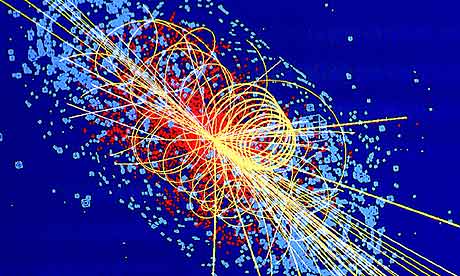
Particle physics (or high-energy physics) is a branch of physics that studies subatomic particles (also called fundamental or elementary particles) and the forces that act on them.
One of the main ideas in particle physics is of the Standard Model. According to the Model, there are three kinds of subatomic particles (which can have traits such as different spin, electric charge, mass, and lifetimes): quarks (up, down, charm, strange, top, and bottom), leptons (electron, muon, tau, electron neutrino, muon neutrino, and tau neutrino), and bosons. The bosons are the exchange particles of the four fundamental forces: the weak force (W and Z bosons), electromagnetic force (photons), strong force (gluons), and gravity (Higgs boson). The Higgs boson has yet to be found, so the Standard Model is currently incomplete, but there are ongoing experiments at
CERN trying to find the Higgs.
(This is could be my all-time favorite video on YouTube. I mean it.)
The field heavily relies on the use of particle accelerators (atom
smashers). They are machines that accelerate matter using magnetic
fields and force particles to collide, the most famous of them
probably being the
Large Hadron Collider. Data is also gathered by recording cosmic radiation.
Some questions beyond the Higgs boson and the Standard Model include dark matter, supersymmetry ((the idea that there may be "shadow particles" for all fundamental particles), and extra dimensions. There is also antimatter, which carries the opposite charge as regular matter; for example, since an electron has a negative charge, an anti-electron is a positron. Antimatter is thought to have had a role in the Big Bang, in that matter and antimatter existed evenly at the very beginning and unequal decay of antimatter left behind the matter existing today (baryogenesis).
Notable Particle Physicist:
Lisa Randall
Lisa Randall is the Frank B. Baird, Jr. Professor of Science at Harvard University and a former professor at Princeton University and the Massachusetts Institute of Technology (MIT), who earned a Ph.D. from Harvard in Theoretical Particle Physics. She was the first tenured woman in the physics department at Princeton and the first tenured female theoretical physicist at Harvard and MIT.
She is a member of the National Academy of Sciences, the American Philosophical Society, and the American Academy of Arts and Sciences, and was the recipient of a National Science Foundation Young Investigator Award, Alfred P. Sloan Foundation Research Fellowship, the Department of Energy (DOE) Outstanding Junior Investigator Award, the Premio Caterina Tomassoni e Felice Pietro Chisesi Award (University of Rome), the Klopsteg Award from the American Society of Physics Teachers, and the Julius Lilienfield Prize from the American Physical Society.
In 2007, she was listed by
Time magazine as one of the 100 Most Influential People. She is the author of
Warped Passages: Unraveling the Mysteries of the Universe's Hidden Dimensions and
Knocking on Heaven's Door: How Physics and Scientific Thinking Illuminate the Universe and the Modern World.
Her research involves particle physics and cosmology, and her work has contributed to knowledge about the Standard Model, supersymmetry, baryogenesis, cosmological inflation, dark matter, and other spatial dimensions.
**********
Sources:
http://www.britannica.com/EBchecked/topic/445074/particle-physics
http://www.edge.org/3rd_culture/randall05/randall05_index.html
http://hepwww.rl.ac.uk/public/phil/ppintro/ppintro.html
http://www.merriam-webster.com/dictionary/particle%20physics
http://www.thefreedictionary.com/particle+physics
http://www.time.com/time/specials/2007/time100/article/0,28804,1595326_1595329_1615997,00.html
http://www.particle-physics.com/information.html
http://www.physics.harvard.edu/people/facpages/randall.html
http://randall.physics.harvard.edu/CV.html
http://www.wisegeek.com/what-is-particle-physics.htm
**********
How likely do you think it is that the Large Hadron Collider will find the Higgs boson?
-----The Golden Eagle