Showing posts with label The Universe. Show all posts

24 April, 2012

A-Z Blogging Challenge: Unified Theory

Hubble Ultra Deep Field. Public domain image. SOURCE.
The Unified Theory of physics, also known as the Grand Unified Theory (GUT) or Theory of Everything (TOE), is a yet-to-be-found theory that would bring together the strong force, weak force, electromagnetic force, and gravity into a single theory.

The history of the search for a unified theory started with James Maxwell, who from 1861-65 demonstrated that electricity and magnetic fields were related, in his theory of electromagnetism. Then, in 1881-84, Heinreich Hertz discovered light and radio waves were also examples of electromagnetism. Albert Einstein tried for 30 years but could not find a theory that united the remaining forces.

There have been several theories proposed as solutions to GUT. One is supersymmetry (it proposes that all matter has a massive "shadow" force carrier), and another string theory (the idea there are more than three dimensions and that particles consist of strings and membranes), but there is no theory that has been broadly accepted.


And today there are three Notable scientists who have worked on unified field-related research. Three, because I was having trouble narrowing it down to one (links will take you to past A-Z Challenge posts on this blog, with the info about the scientists at the bottom):


**********

Sources:
http://www.britannica.com/EBchecked/topic/614522/unified-field-theory
http://dictionary.reference.com/browse/unified+field+theory
http://www.grandunifiedtheory.co.uk/
http://www.livescience.com/9513-greatest-mysteries-theory.html
http://www.particleadventure.org/grand.html
http://www.pbs.org/wgbh/nova/physics/theory-of-everything.html
http://pdg.web.cern.ch/pdg/cpep/unified.html
http://physics.about.com/od/quantumphysics/f/uft.htm
http://searchcio-midmarket.techtarget.com/definition/unified-field-theory
http://www.thefreedictionary.com/grand+unified+theory

**********

If a unified theory is found, what kind of effect do you think it will have on physics? On other fields?


-----The Golden Eagle

19 April, 2011

A-Z Blogging Challenge: P Stands For: Particle Physics

Particle physics is a branch of physics that studies the elementary particles of matter and radiation. An elementary, also called fundamental, particle is something that has no substructure--it is not made up of smaller particles. Particle physics is also referred to as high energy physics, because fundamental particles can only be created in particle accelerators.


The classification of all those particles comes together in the Standard Model. The Standard Model has only twelve basic particles, which are governed by four forces.

The twelve matter particles are quarks and leptons. Each of these two groups has "generations"--the first generation being lighter and more stable, while the second and third are heavier and less stable. All the stable matter in the universe belongs to the first generation, because the particles that make up the second and third decay to a more stable level.


There are up quarks, down quarks, charm quarks, strange quarks, top quarks, and bottom quarks, to cover the first six out of the twelve. Then there are electrons, electron-neutrinos, muons, muon-neutrinos, taus, and tau-neutrinos.


Three of the four fundamental forces--the strong force, the weak force, the electromagnetic force, and the gravitational force--result because of the exchange of "force carrier particles", called bosons. Fundamental particles exchange these bosons and, therefore, discrete amounts of energy. The strong force is carried by the gluon, the weak force by the W and Z bosons, the electromagnetic force by the photon, and the graviton for the gravitational force has not been found yet.


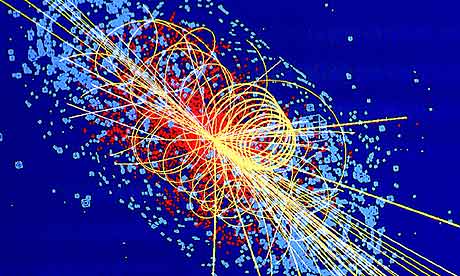
And last but not least, there's the Higgs Boson, which is thought to be the reason other particles have mass. The boson is predicted to exist because of the Standard Model, which incorporates it to solve problems with current theoretical physics. Experiments are being done to prove its existence with the Large Hadron Collider at CERN and Tevatron at Fermilab (although the latter will cease operations in September), but it has yet to be observed.


*****

A very cool video on the Standard Model (the scientists probably explain things way better than I do):


Sources:
http://public.web.cern.ch/public/en/science/StandardModel-en.html
http://en.wikipedia.org/wiki/Standard_model
http://particleadventure.org/index.html
http://en.wikipedia.org/wiki/Elementary_particle
http://en.wikipedia.org/wiki/Particle_physics
http://en.wikipedia.org/wiki/Higgs_boson
http://en.wikipedia.org/wiki/Tevatron
http://www.universetoday.com/26829/fermilab-putting-the-squeeze-on-higgs-boson/

*****

What do you think of particle physics? Do you think the Higgs boson will be found soon? Do you think the Standard Model, despite the fact it omits gravity from the calculations, will continue to be the way scientists describe fundamental particles?


-----The Golden Eagle
Enhanced by Zemanta

08 April, 2011

A-Z Blogging Challenge: G Stands For: Galaxies

Up to 30 septillion stars make up the 80 billion or so galaxies in the universe. A galaxy consists of stars, stellar remnants, dust, and dark matter.

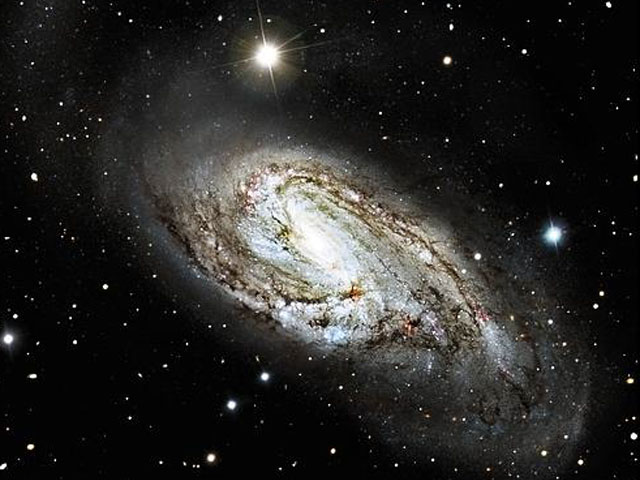
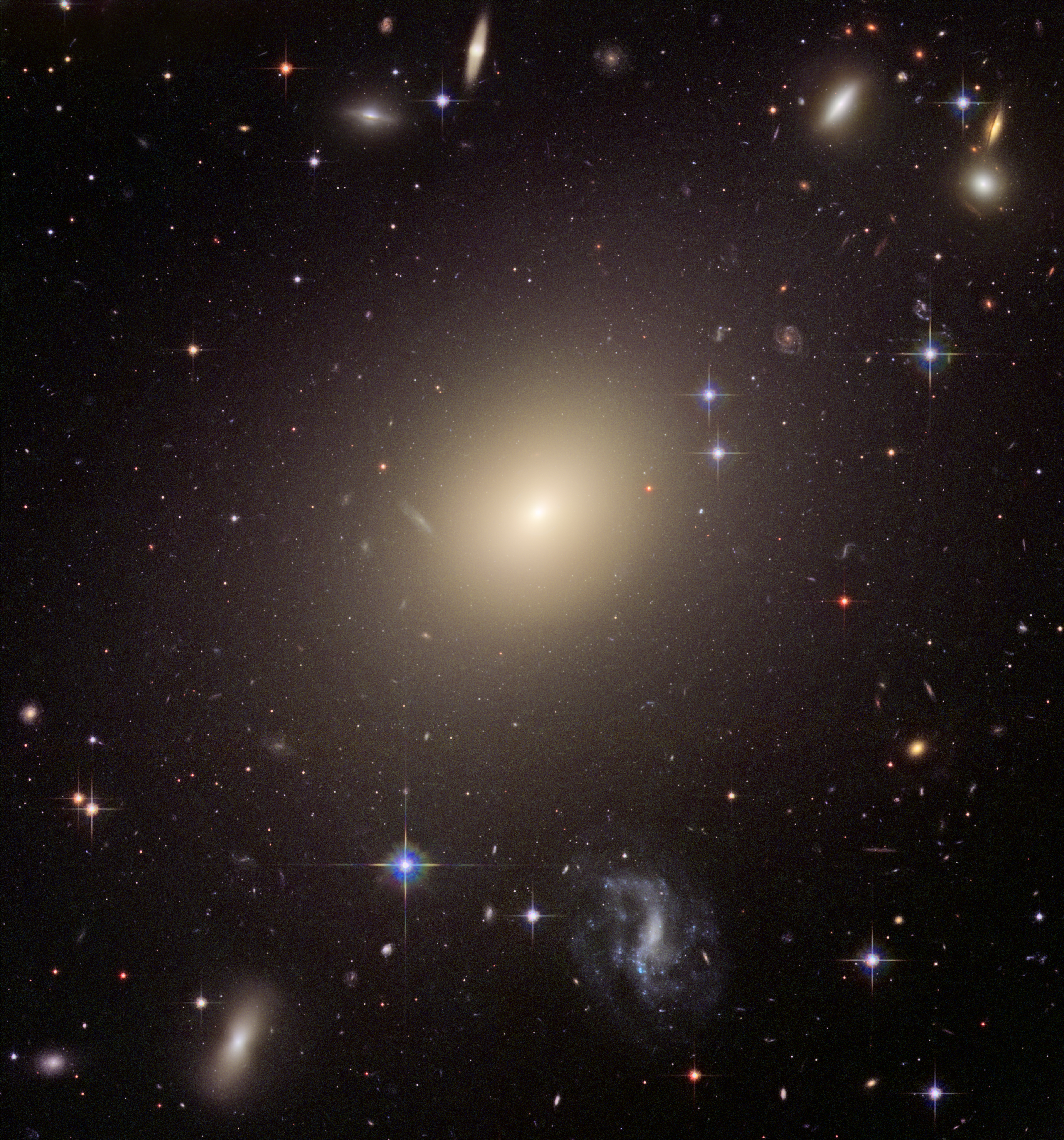
There are three major types: spiral, elliptical, and irregular.

An example of a spiral galaxy:


And example of an elliptical galaxy:


And example of an irregular galaxy:


Galaxies also form clusters and superclusters, the latter of which are galaxies that are not gravitationally bound to one another. Such groups make up much of the structure of the universe.

The Virgo Supercluster includes the Virgo Cluster and the Local Group. Andromeda and the Milky Way are included in the Local Group--and, therefore, us. The Virgo Supercluster's diameter is 33 megaparsecs, which is the equivalent of 110 light years.


*****

Sources:
http://en.wikipedia.org/wiki/Galaxy
http://en.wikipedia.org/wiki/Virgo_Supercluster

*****

Do you think there's a chance of alien life in one of those billions of galaxies? Do you think people will ever find a way to cross "galactic" distances efficiently?


-----The Golden Eagle
Enhanced by Zemanta