Showing posts with label Volcanoes. Show all posts

25 April, 2013

A To Z Challenge: Volcanology And Volcanoes Building Up Steam

Volcanology, also known as vulcanology (though it has nothing to do with Spock), is a branch of geology that studies volcanoes in addition to associated phenomena such as material expelled during an eruption and the plate tectonics that creates volcanoes. The field also includes geodesy, geophysics, and geochemistry.

Recently, scientists have reevaluated their model of the Yellowstone caldera (also called a supervolcano or megavolcano), estimating that there is 50% more magma beneath the surface than previously thought and that the magma is contained within a single large chamber. Yellowstone National Park is, technically, a volcano in the process of preparing to explode once again, generating 1,000-3,000 earthquakes a year and displaying thermal activity on the surface--the last time it erupted was 640,000 years ago, though there have been smaller events as geologically recent as 70,000 years ago.

**********

Sources:
http://www.thefreedictionary.com/volcanology
http://www.britannica.com/EBchecked/topic/632202/volcanology
http://vulcan.wr.usgs.gov/Outreach/StudyVolcanoes/
http://www.pbs.org/wgbh/nova/earth/deadliest-volcanoes.html
http://www.nps.gov/yell/naturescience/volcanoqa.htm
http://www.livescience.com/28821-yellowstone-supervolcano-bigger-plume.html

**********

Are there any volcanoes in your region? Have you ever been to Yellowstone? 


----The Golden Eagle

25 April, 2012

A-Z Blogging Challenge: Volcanology

Public domain image. SOURCE.
Volcanology, also known as vulcanology, is the study of volcanoes.

The field examines the formation and classification of volcanoes, matter expelled during eruptions (pyroclastic flows, lava, dust, ash, gases), volcanic relations to other geologic events (mountain building, earthquakes), and attempts to predict when volcanoes may erupt. It also involves geophysics, geochemistry, seismology, and geodesy.

Volcanoes form because of rising magma from beneath the surface of Earth, usually close to the edges of tectonic plates. There are three types of volcanic activity: spreading center volcanism (takes place along diverging plates), subduction zone volcanism (takes place where two plates converge) and intraplate volcanism (takes place mid-plate where there are no plate edges).

Volcano types are further classified as cones (steeply sloped with the typical volcano shape), shield volcanoes (shallow sloped), and stratovolcanoes (also known as composite volcanoes; they are shallow at the base, curves sharply upward toward the top). Some major kinds of eruptions include fissure eruptions (eruptions occur along a line), Hawaiian eruptions (relatively calm flows of basalt lava with little volcanic gas), Strombolian eruptions (explosive, noisy eruptions that involve a lot of volcanic gas), Vulcanian eruptions (short series of eruptions that send up a lot of rocks at the onset but become quieter and steadier after some time), Plinian eruptions (generate plumes of ash that travel up to 45 km into the air), and hydrovolcanic eruptions (eruptions that happen in water).

By Ahjartar, CC-BY-SA-3.0. SOURCE.
Notable Volcanologist:

Haraldur Sigurðsson

Haraldur Sigurðsson is a volcanologist and marine geologist. He received a Ph.D. in Petrology/Geochemistry from Durham University and is a current Professor of Oceanography at the University of Rhode Island. He has studied volcanoes in Iceland, North America, South America, the Caribbean, Indonesia, Italy, and Africa, and has researched underwater volcanoes. He was awarded the Coke Medal by the Geological Society of London for his work. Sigurðsson has also hosted several TV documentaries, including The Riddle of Pompeii, Horizon, Naked Science, and Timewatch.


Video with Haraldur Sigurðsson (embedding was disabled, so I couldn't put it directly in this post):


http://youtu.be/xz99nuPURXA?hd=1


**********

Sources:
http://www.britannica.com/EBchecked/topic/632202/volcanology
http://www.geology.sdsu.edu/how_volcanoes_work/
http://www.geolsoc.org.uk/gsl/society/history/page2983.html
http://www.geo.mtu.edu/volcanoes/
http://www.gso.uri.edu/users/haraldur
http://www.imdb.com/name/nm1475311/
http://www.learner.org/interactives/volcanoes/meltrock.html
http://www.plate-tectonics.org/volcanoes/
http://pubs.usgs.gov/gip/volc/cover2.html
http://www.thefreedictionary.com/volcanology
http://www.tomgidwitz.com/main/explorer.htm
http://www.uri.edu/endeavor/thera/bio-sig.html
http://volcano.oregonstate.edu/education/vwlessons/kinds/kinds.html

**********

Do you live near any volcanoes?


-----The Golden Eagle

09 April, 2011

A-Z Blogging Challenge: H Stands For: Herculaneum

I know I've posted about this before, but since I really do think this city deserves more attention . . . have you ever heard of Herculaneum?


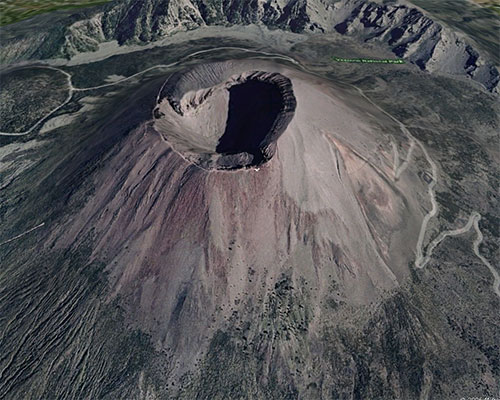
You know, the city that got destroyed by Vesuvius in 79 AD?

Yes, Pompeii was bigger. Yes, they found buildings and macabre human-shaped cavities. Yes, there is some interesting stuff at the city.

But I still think Herculaneum is cooler.


Recently, archaeologists have found the old basilica, a painted statue head, mosaics, a loaf of bread, even wooden structures such as furniture and buildings, thanks to the heat and intensity the pyroclastic flow. And that's after people back in the 1700s or so looted the place, digging tunnels throughout the ruins (Herculaneum was buried under 65+ feet of ash) and hacking apart many of the paintings to sell.

The only problem with excavating it is that there's a city above the ruins.


Of course, having a city there is rather dangerous. If Vesuvius erupts again like the way it did in 79 AD--and that's not impossible in the least--it could mean a disaster many, many times greater than the one thousands of years ago. 6 million people live where Herculaneum, Pompeii, Stabiae, and Oplontis (those are the other towns destroyed) used to be. Evacuation plans for the Bay of Naples only account for 600,000.

*****

If you'd like to learn more, go HERE to the PBS Secrets of the Dead and watch the video.

Sources:
http://en.wikipedia.org/wiki/Herculaneum

*****

The danger of a volcanic eruption aside, it's a cool site, don't you think?


-----The Golden Eagle

28 October, 2010

Herculaneum Was There, Too!

You've heard of Pompeii, I bet. You also probably know what happened that day, August 24th 79 AD. But did you know about Herculaneum?

I've noticed that in a lot of history books there's practically nothing about Herculaneum. The most I've found is a mention that it was buried under 65 feet of ash. You would think that there would be more about a city buried under 65 feet of ash, but unfortunately, no.

That's why I was thrilled when Secrets of the Dead: Herculaneum Uncovered was aired last night:


Because someone had decided this Roman city was finally worth looking into!

I didn't know about much of what they said. Like, that the Bourbons looted the place through a maze of tunnel leading underground. Or that the citizens of Herculaneum hid in the boat sheds as the pyroclastic flows enveloped their city. Or that 2000 year-old-bread is in existence, and even has its owner's name on it. There's ancient, carbonized furniture, and some pieces of wood that were not carbonized.


But even Pompeii and Herculaneum weren't the only cities--Stabiae and Oplontis were also wiped out.

I always find less-discovered places and people fascinating. There's so much more to learn that way. :)


-----The Golden Eagle