Showing posts with label Ice. Show all posts

27 April, 2011

A-Z Blogging Challenge: W Stands For: Water

Water is one oxygen atom and two hydrogen atoms: H20.


Because of the way the hydrogen atoms are attached, water molecules have a slight positive charge and a slight negative charge, which attracts the other water molecules around them. The polar nature of water means it has a high surface tension--and that tension decreases with temperature. This is why hot water cleans better, since there's less surface tension and the water can get into all the smaller pores and whatnot. Soaps and detergents also lower surface tension.


Water has three states of matter. There's water as a solid (ice), water as a liquid (which is what we usually know it as), and water as gas (steam). Water going from solid to liquid is melting, liquid to gas is evaporating, gas to liquid is condensation, gas to solid is frost formation, and solid to gas is sublimation.


Water forms from the nuclear fusion at the core of stars. When the hydrogen that's fused into helium is used up and the helium begins to fuse, oxygen is produced. Then iron is formed, and there are no stable reactions possible to fuse the iron, so the star explodes. The supernova remnants get thrown out through space and the elements (including oxygen) are free in the interstellar medium. And since hydrogen is three times more abundant than helium, oxygen and hydrogen eventually bind together.

***Due to problems with bandwidth (the site inserted an image in here that said "STOP THIEF"--or, more accurately, it was "STOP THEIF") I removed this image. Check link below to see the image.***

Because water is (at least here on Earth, and it's likely to be the same elsewhere) vital for life, there's a hunt on to find it in other places throughout the universe. Some places it has been found include the Moon (more famously in the form of NASA's LCROSS spacecraft which purposefully crashed into the surface), comets, and Mars. There are signs of water on Europa and Ganymede (Jupiter's moons), and the spectrum (the wavelength of light emitted by atoms) of water has been found in interstellar clouds.


*****

Sources:
http://hyperphysics.phy-astr.gsu.edu/hbase/surten.html
http://en.wikipedia.org/wiki/H2O
http://ga.water.usgs.gov/edu/index.html
http://en.wikipedia.org/wiki/Water
http://www.uni.edu/~iowawet/H2OProperties.html
http://witcombe.sbc.edu/water/physicsuniverse.html

*****

Do you think we'll find out for sure that there are large quantities of water on other planets? Do you think we'll ever be using water from other planets or moons to help us travel through space?


-----The Golden Eagle
Enhanced by Zemanta

11 April, 2011

A-Z Blogging Challenge: I Stands For: Ice

***An unfinished version of this post accidentally published this morning. My fault, because I meant to say 12:00 PM, not 12:00 AM. Sorry about that. Just another reason why a switch should be made to 24 HOUR TIME. It would make life so much easier. Anyway, I'll rant some other time (that's hopefully in 24-hour!)--on with the post.***

I've already covered Cold (go HERE to read that post) but ice is a very different state of matter.


Essentially water frozen into a solid state, ice is the "most abundant of the varying solid phases on Earth's surface". The most common phase transition (i.e. the most common way ice forms) is when water is cooled to 0 C/273.15 K/32 F at standard atmospheric pressure, depending on which temperature scale you use. It can also form without going through a liquid state, such as when vapor turns into frost.


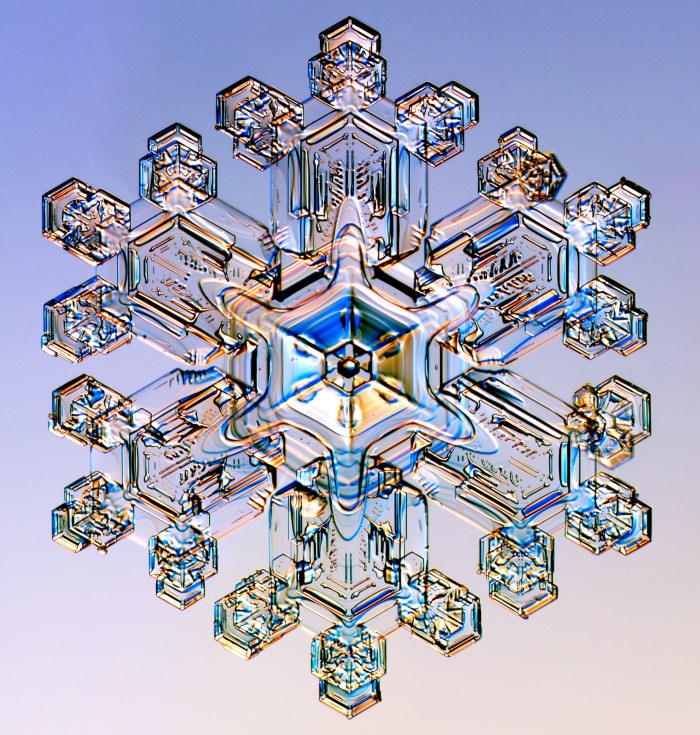
Ice is officially considered a mineral. Its crystalline structure is based on water molecules, which consist of  covalent bonds between oxygen atoms and two hydrogen atoms. Weak, adjacent hydrogen bonds between molecules control much of the physical properties of water and ice.


The only non-metallic structure known to expand when it cools, frozen water is 9% less dense than liquid water. This is because the hydrogen atoms have a slight positive charge, and the oxygen atoms have a slight negative charge, and the solid hexagonal structure that forms because of their bond takes up more space than when water is moving freely in liquid state.


Ice is one of 15 known crystalline phases of water. Besides Ih, which is your usual frozen water, there is:

Amorphous Ice (ice without any crystal structure).
Ice Ic (ice where oxygen atoms are arranged in a diamond shape, produced at temperatures of 130 and 220 K).
Ice II (ice with a rhombohedral crystalline structure, formed by compressing Ih at 190-210 K).
Ice III (ice with a tetragonal crystalline structure, formed by cooling water to 250 K at 300 MPa--MPa stands for megapascal. One megapascal is one million pascals, and a pascal is one newton of force per square meter).
Ice IV (ice in a metastable rhombohedral phase. (Metastable means in a state of equilibrium, but easily sent into a lower energy state with only slight interaction.) It is formed by heating amorphous ice at a pressure of 810 MPa).
Ice V (ice in a monoclinic crystalline phase, and the most complicated of all phases. It is formed by cooling water down to 253 K at 500 MPa.)
Ice VI (ice with a tetragonal crystalline structure and formed by cooling water to 270 K at 1.1 GPa. GPa stands for one billion (thousand million) pascals.)
. . . and for the other phases, go HERE.

(I couldn't resist sharing an eagle sculpture. SOURCE)

*****

Sources:
http://en.wikipedia.org/wiki/Ice
http://www.word-detective.com/howcome/waterexpand.html
http://hyperphysics.phy-astr.gsu.edu/hbase/chemical/waterdens.html
http://en.wikipedia.org/wiki/Pascal_(unit)
http://www.sensorsone.co.uk/pressure-measurement-glossary/mpa-megapascal-pressure-unit.html


*****


Thoughts on ice?


-----The Golden Eagle