Showing posts with label Astronomy. Show all posts

08 April, 2013

A To Z Challenge: Geodesy And GPS

Geodesy is the study of planet Earth's physical characteristics. It uses mathematics to determine precise geographical points and measure the size and shape of sections of the surface; geodesy also includes physics and astronomy to make calculations and build accurate models of the planet.

One leap in geodesy has been the arrival of satellite technology. As you might expect, this has greatly expanded the amount of data available--scientists can now see things that had been previously out of view. Studies of the water cycle, glaciers and ice sheets, atmospheric temperature, and other global events have since revealed complex interactions across continents.

However, the most familiar application of geodesy is probably your everyday Global Positioning System or GPS. Geodesy is the scientific field that developed techniques for pinpointing an object's location on the surface and methods of tracking said object. In many cases, this is likely your car or phone.

**********

Sources:
http://www.thefreedictionary.com/geodesy
http://www.jqjacobs.net/astro/geodesy.html
http://oceanservice.noaa.gov/facts/geodesy.html
http://oceanservice.noaa.gov/education/tutorial_geodesy/
http://www.ngs.noaa.gov/PUBS_LIB/Geodesy4Layman/TR80003A.HTM#ZZ2
http://www.agu.org/sections/geodesy/
http://www.pbs.org/wgbh/nova/space/earth-from-space.html

**********

Have you ever tried GPS? Do you use it often? Have you ever run into glitches like we did once, where it sent us around a roundabout an extra few miles because it didn't understand the building we were looking for was on the other side of the roundabout?


-----The Golden Eagle

03 April, 2012

A-Z Blogging Challenge: Cosmology

Timeline of the universe. Public domain image. SOURCE.
Cosmology is the study of the nature of the universe.

As with astrophysics (covered on Sunday), it is a branch of astronomy. Cosmology as we think of it now began to take off in the early 1900s, when Edwin Hubble (the Hubble Telescope was named after him) made the discovery that so-called "spiral nebulae" were actually galaxies whose light was shifted toward the red end of the spectrum, a phenomenon called "red-shift"; this results when an object is in motion. He proposed that galaxies are red-shifted because they are moving away from our own, the Milky Way, which in turn led to the idea that at one point, the universe exploded from an extremely dense point in what's known as the Big Bang.

Another scientist who made major contributions to cosmology was Albert Einstein with his Theory of General Relativity (which will be explored in greater detail on Saturday), a theory that brought together space and time, formerly considered separate, into a single entity called spacetime. Einstein also came up with the idea that spacetime is curved, thanks to gravity.

Spacetime curvature by Johnstone, CC-BY-SA-3.0. SOURCE.

The theories that the universe might have been in one location all at one time and that spacetime is unified doesn't mean the field is over and closed, however; rather, it's very far from it. Some current questions in cosmology are whether or not the universe is really infinite, whether it will stop expanding at some point and come together in a Big Crunch (indicating that the universe might expand and contract cyclically) or everything will continue to accelerate away from each other, why there is more matter than antimatter, the role of dark matter and dark energy, and (if the Big Bang theory is true) what occurred just after the beginning of the universe (since all laws break down at that point).


Public domain image. SOURCE.
Notable Cosmologist:


Stephen Hawking

Stephen Hawking is probably one of science's--and cosmology's--most famous figures. He became a Research Fellow and then a Professorial Fellow at Gonville and Caius College, and took the position of Lucasian Professor of Mathematics from 1979-2009, a title formerly held by Isaac Newton; he is currently the Director of Research at the Centre for Theoretical Cosmology at Cambridge University.

He and Roger Penrose showed that the General Theory of Relativity indicated there must be unification between quantum theory and general relativity; he also came up with the theories that black holes are not black--instead, they emit radiation--and that the universe has no edge. He has published a series of scientific papers, in addition to A Brief History of Time, Black Holes and Baby Universes and Other Essays, The Universe in a Nutshell, A Briefer History of Time, On the Shoulders of Giants, the Middle Grade Fiction George's Secret Key to the Universe (and the subsequent novels in the trilogy), and his most recent The Grand Design.

At the age of 21, he was diagnosed with amyotrophic lateral sclerosis (ALS, also called Lou Gehrig's disease or motor neuron disease) and told he had one to two years left to live. But, rather remarkably, he lived far beyond that and is currently 70 years old.

Stephen Hawking received the CBE (Order of the British Empire) in 1982 and became a Companion of Honour in 1989.

A video about the universe with Stephen Hawking:


**********


Sources:
A Brief History of Time by Stephen Hawking
http://www.aip.org/history/cosmology/ideas/journey.htm
http://www.astro.ucla.edu/~wright/cosmolog.htm
http://www.hawking.org.uk/index.html
http://map.gsfc.nasa.gov/universe/index.html
http://www.merriam-webster.com/dictionary/cosmology
http://www.newscientist.com/article/dn9988-introduction-cosmology.html
http://starchild.gsfc.nasa.gov/docs/StarChild/universe_level2/cosmology.html
http://superstringtheory.com/cosmo/index.html
http://www.thefreedictionary.com/cosmology

**********


What do you think? Will the universe expand forever, or will it stop and begin contracting into the Big Crunch? Do you think humanity will ever figure out how the universe began and how it will end, definitively?


-----The Golden Eagle

01 April, 2012

A-Z Blogging Challenge: Astrophysics

The Milky Way Galaxy. Public domain image. SOURCE.
Astrophysics, to put it rather briefly and broadly, is the study of how the universe works.
It differs from cosmology (which is Tuesday's subject for the A-Z Challenge) in that it usually focuses on physical and chemical properties of the universe, while cosmology deals more with the nature and laws of the universe. The line between the two is not that great, however, and they're both part of astronomy, which is an even larger field that includes the study of everything outside of Earth's atmosphere.

A few current research subjects in astrophysics are black holes (points where gravity is so powerful that light, traveling at its tremendous 299,792,458 meters per second, cannot escape), planet, galaxy, and star formation, the interstellar medium (gas, dust, charged particles, and anything else between stars), dark matter and energy (dark energy is thought to constitute 70% of the universe and dark matter 25%), and the possibility of life in the universe beyond Earth (in addition to how it may have arrived here on Earth, if it did so).


Notable Astrophysicist:

Neil deGrasse Tyson

Public domain image. SOURCE.
Neil deGrasse Tyson is the current director of the Hayden Planetarium at the Rose Center for Earth and Space in NYC and is a Research Associate at the American Museum of Natural History. He graduated from Columbia University with a PhD in Astrophysics. He was also appointed to two presidential commissions (one on the aerospace industry and another on space exploration), is the author of over ten books including The Pluto Files: The Rise and Fall of America's Favorite Planet, Death By Black Hole and Other Cosmic Quandaries, Origins: Fourteen Billion Years of Cosmic Evolution (with Donald Goldsmith), and his most recent Space Chronicles: Facing the Ultimate Frontier.

He is the host of StarTalk Radio, NOVA ScienceNOW, and the two NOVA programs The Pluto Files and Origins (both based on his books) and was given the NASA Distinguished Public Service Medal. In addition, he has written many scientific papers. He is also the host of an upcoming 13-part sequel to Carl Sagan's Cosmos: A Personal Voyage, due to air in 2013.
On a less scientific note, People declared Neil deGrasse Tyson the Sexiest Astrophysicist Alive in 2000, and the International Astronomical Union named an asteroid after him--13123 Tyson.

Video narrated by Neil deGrasse Tyson about the most astounding fact to the universe:


**********

Sources:


http://csep10.phys.utk.edu/astr162/lect/milkyway/ism.html
http://www.haydenplanetarium.org/tyson/profile/about-neil-degrasse-tyson
http://www.haydenplanetarium.org/tyson/curriculum-vitae
http://hubblesite.org/explore_astronomy/black_holes/
http://www.merriam-webster.com/dictionary/cosmology
http://www.merriam-webster.com/dictionary/astronomy
http://www.merriam-webster.com/dictionary/astrophysics
http://www.people.com/people/archive/article/0,,20132902,00.html
http://physics.about.com/od/astronomy/Cosmology_Astrophysics.htm
http://www2.physics.ox.ac.uk/research/astrophysics
http://research.amnh.org/astrophysics/research
http://science.nasa.gov/astrophysics/
http://science.nasa.gov/astrophysics/focus-areas/what-is-dark-energy/
http://www.startalkradio.net/
http://www.wired.com/geekdad/2011/08/cosmos-to-get-a-sequel-hosted-by-neil-degrasse-tyson/

**********

What do you think of astrophysics? And as today is the kickoff of the A-Z Challenge: how is the Challenge starting off for you?


-----The Golden Eagle
27 April, 2011

A-Z Blogging Challenge: W Stands For: Water

Water is one oxygen atom and two hydrogen atoms: H20.


Because of the way the hydrogen atoms are attached, water molecules have a slight positive charge and a slight negative charge, which attracts the other water molecules around them. The polar nature of water means it has a high surface tension--and that tension decreases with temperature. This is why hot water cleans better, since there's less surface tension and the water can get into all the smaller pores and whatnot. Soaps and detergents also lower surface tension.


Water has three states of matter. There's water as a solid (ice), water as a liquid (which is what we usually know it as), and water as gas (steam). Water going from solid to liquid is melting, liquid to gas is evaporating, gas to liquid is condensation, gas to solid is frost formation, and solid to gas is sublimation.


Water forms from the nuclear fusion at the core of stars. When the hydrogen that's fused into helium is used up and the helium begins to fuse, oxygen is produced. Then iron is formed, and there are no stable reactions possible to fuse the iron, so the star explodes. The supernova remnants get thrown out through space and the elements (including oxygen) are free in the interstellar medium. And since hydrogen is three times more abundant than helium, oxygen and hydrogen eventually bind together.

***Due to problems with bandwidth (the site inserted an image in here that said "STOP THIEF"--or, more accurately, it was "STOP THEIF") I removed this image. Check link below to see the image.***

Because water is (at least here on Earth, and it's likely to be the same elsewhere) vital for life, there's a hunt on to find it in other places throughout the universe. Some places it has been found include the Moon (more famously in the form of NASA's LCROSS spacecraft which purposefully crashed into the surface), comets, and Mars. There are signs of water on Europa and Ganymede (Jupiter's moons), and the spectrum (the wavelength of light emitted by atoms) of water has been found in interstellar clouds.


*****

Sources:
http://hyperphysics.phy-astr.gsu.edu/hbase/surten.html
http://en.wikipedia.org/wiki/H2O
http://ga.water.usgs.gov/edu/index.html
http://en.wikipedia.org/wiki/Water
http://www.uni.edu/~iowawet/H2OProperties.html
http://witcombe.sbc.edu/water/physicsuniverse.html

*****

Do you think we'll find out for sure that there are large quantities of water on other planets? Do you think we'll ever be using water from other planets or moons to help us travel through space?


-----The Golden Eagle
Enhanced by Zemanta

16 April, 2011

A-Z Blogging Challenge: N Stands For: Nebula

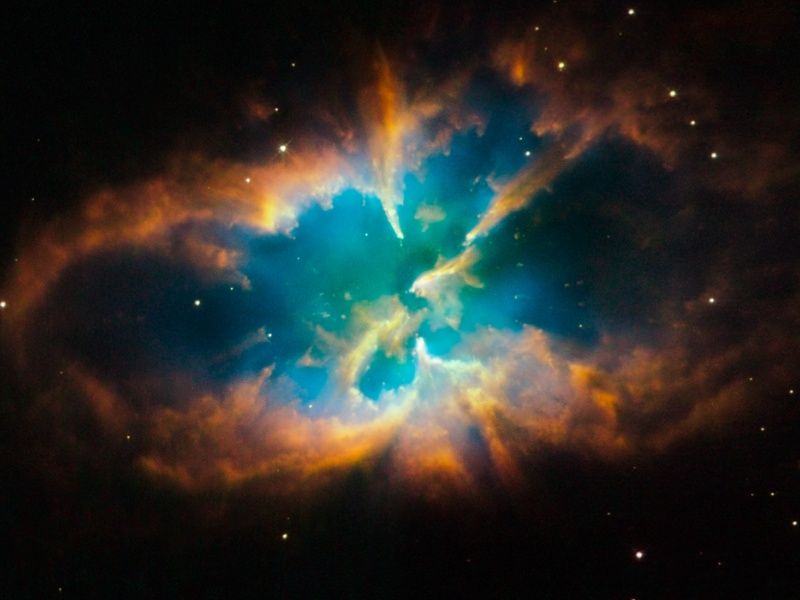
A nebula is an interstellar cloud of dust, hydrogen, helium, and other ionized gases.

(The Eagle Nebula SOURCE)

They are often star-forming regions. 

Stars form when gas, dust, and other materials out in space begin to gather together, forming larger and denser masses, which collect until there are huge clumps of dust and gas. The clumps are called protostars, and as gravity acts on the material, compressing it further, it heats up to over 10,000,000 degrees Kelvin. That is the point were hydrogen fusion can begin.

Hence, a star.

There are two sources of nebulae: exploding stars and material from the original formation of the universe.

(Rosette Nebula SOURCE)

There are also five major types. Emission, Reflection, Dark, Planetary, and Supernovae Remnants. (One thing I love about astrophysics--they keep the names in plain English.)

Emission:

(Orion Nebula SOURCE)

Reflection:

(NGC 1977 SOURCE)

Dark:
(Keyhole Nebula SOURCE)

Planetary:
(NGC 2818 SOURCE)

Supernovae remnants:

(Crab Nebula SOURCE)

And some more pictures:


*****

Sources:

*****

Have you ever seen a nebula? (As in, not just a picture but through a telescope or with your own eyes?)

-----The Golden Eagle
Enhanced by Zemanta