Showing posts with label Water. Show all posts

17 April, 2012

A-Z Blogging Challenge: Oceanography

Autonomous underwater vehicle, by StifynTonna, CC-BY-SA-3.0. SOURCE.
Oceanography (sometimes called oceanology) is the study of the world's oceans, including the life they support, their physical and chemical characteristics, the ocean floors, and exploration of the oceans.

The history of the field began with early explorers such as Captain James Cook, who mapped coastlines and explored the Great Barrier Reef. Another figure (though more well known for his theory of evolution) who contributed significant early research was Charles Darwin, who published a paper about coral reefs and atoll formation.

There are four branches of oceanography: physical oceanography (the temperature, density, pressure, and other properties of seawater), chemical oceanography (the composition and biogeochemical processes that affect it), marine geology (the structure and evolution of ocean basins), and marine ecology (also called biological oceanography; it is the study of ocean-dwelling plants and animals). There is also Ocean Engineering, which involves the design and manufacture of objects to be used in water. The overall field of oceanography incorporates biology, chemistry, geology, meteorology, and physics.

Information about currents, waves, ocean fronts, and variations in magnetic and gravitational fields are taken using special instruments, with recent technology such as satellites taking over for observations that were formerly made from aircraft, buoys, and ships; satellites are also capable of  mapping the ocean surface, currents, waves, winds, phytoplankton levels, sea ice, rainfall, and sea surface temperature. Autonomous undersea vehicles (or AUVs) are another type of machine used that does not require people to be out on the water. Many measurements are now electronic, and probes that can test chemical and biological factors are being used and developed.

Public domain image. SOURCE.
Notable Oceanographer:

Gene Carl Feldman


Gene Carl Feldman is an oceanographer who has been at NASA since 1985. His projects have included sea turtle conservation, the production, archival, and distribution of satellite data, SeaWiFS (Sea-viewing Wide Field-of-view Sensor, which aimed to provide information on ocean color, or its "bio-optical properties"), hydrothermal vents, exploring the Kaikoura Canyon in New Zealand, and underwater dives. He has been part of programs involving the BBC, Discovery Channel, National Geographic Society, Cousteau Society, Smithsonian, and PBS, and he created the JASON Project with Robert Ballard, another oceanographer.


Video with Gene Carl Feldman talking about the Galapagos Islands and oceanography:


**********

Sources:
http://www.britannica.com/EBchecked/topic/424573/oceanography
http://geography.about.com/od/waterandice/a/oceanography.htm
http://inventors.about.com/od/ofamousinventions/a/Oceanography_4.htm
http://www.merriam-webster.com/dictionary/oceanography
http://nasascience.nasa.gov/earth-science/oceanography/
http://oceancolor.gsfc.nasa.gov/SeaWiFS/BACKGROUND/SEAWIFS_BACKGROUND.html
http://oceancolor.gsfc.nasa.gov/staff/gene/
http://www.ocean.washington.edu/about/faq.html
http://www.thefreedictionary.com/oceanography
http://sea.uct.ac.za/what-is-oceanography/
http://www.wisegeek.com/what-is-oceanography.htm

**********

What's your favorite ocean or ocean-going animal? And just for speculation, do you think humans will ever live underwater, or at least develop the technology to do so?


***And I meant to mention this yesterday, but The Eagle's Aerial Perspective REACHED 1000+ FOLLOWERS! Rest assured, there will be a proper celebration post once the A-Z Challenge is over.***


-----The Golden Eagle

23 July, 2011

Award!

Jenny Pearson at Pearson Report recently awarded me The Fancy Fish Award:


Thank you, Jenny! :)

This one comes with a catch, however, and here it is:

I have to link back to Underwater Tales, the origin of this award.

And answer these questions:

Tell us a little about yourself:

  • Do you like to swim?
  • Have you ever swum with dolphins?
  • Do large bodies of water scare you?
  • What's your favorite movie that features water?
  • If you could be a sea creature what would it be?


. . . and "find three pals of the ocean to pass this along to".

Linked, so now to the questions!

Do you like to swim?
I don't know how. The closest I've gotten is floundering about like a fish out of water in a lake. And that was a while ago.

Have you ever swum with dolphins?
Nope. Though I did see a dolphin show, once . . .

Do large bodies of water scare you?
Not really. My tune might change, however, if I actually went out on a boat. I've never been on a boat, either. :P

What's your favorite movie that features water?
Happy Feet. Go, Mumble!

If you could be a sea creature what would you be?
Golden Eagles don't live underwater, do they? Hmm . . . how about a narwhal? Fascinating creatures, narwhals.

And I award:

Petty Witter at Pen and Paper
Alleged Author at An Alleged Author
Misha at My First Book

*********

So what about you? Ever swum with dolphins? :)


-----The Golden Eagle
27 April, 2011

A-Z Blogging Challenge: W Stands For: Water

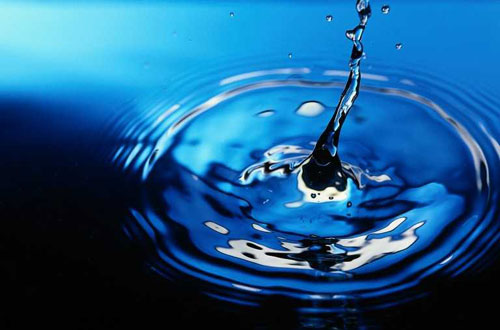
Water is one oxygen atom and two hydrogen atoms: H20.


Because of the way the hydrogen atoms are attached, water molecules have a slight positive charge and a slight negative charge, which attracts the other water molecules around them. The polar nature of water means it has a high surface tension--and that tension decreases with temperature. This is why hot water cleans better, since there's less surface tension and the water can get into all the smaller pores and whatnot. Soaps and detergents also lower surface tension.


Water has three states of matter. There's water as a solid (ice), water as a liquid (which is what we usually know it as), and water as gas (steam). Water going from solid to liquid is melting, liquid to gas is evaporating, gas to liquid is condensation, gas to solid is frost formation, and solid to gas is sublimation.


Water forms from the nuclear fusion at the core of stars. When the hydrogen that's fused into helium is used up and the helium begins to fuse, oxygen is produced. Then iron is formed, and there are no stable reactions possible to fuse the iron, so the star explodes. The supernova remnants get thrown out through space and the elements (including oxygen) are free in the interstellar medium. And since hydrogen is three times more abundant than helium, oxygen and hydrogen eventually bind together.

***Due to problems with bandwidth (the site inserted an image in here that said "STOP THIEF"--or, more accurately, it was "STOP THEIF") I removed this image. Check link below to see the image.***

Because water is (at least here on Earth, and it's likely to be the same elsewhere) vital for life, there's a hunt on to find it in other places throughout the universe. Some places it has been found include the Moon (more famously in the form of NASA's LCROSS spacecraft which purposefully crashed into the surface), comets, and Mars. There are signs of water on Europa and Ganymede (Jupiter's moons), and the spectrum (the wavelength of light emitted by atoms) of water has been found in interstellar clouds.


*****

Sources:
http://hyperphysics.phy-astr.gsu.edu/hbase/surten.html
http://en.wikipedia.org/wiki/H2O
http://ga.water.usgs.gov/edu/index.html
http://en.wikipedia.org/wiki/Water
http://www.uni.edu/~iowawet/H2OProperties.html
http://witcombe.sbc.edu/water/physicsuniverse.html

*****

Do you think we'll find out for sure that there are large quantities of water on other planets? Do you think we'll ever be using water from other planets or moons to help us travel through space?


-----The Golden Eagle
Enhanced by Zemanta

21 April, 2011

A-Z Blogging Challenge: R Stands For: Rovers

Specifically, Spirit and Opportunity.

Artist's rendering of a Mars Exploration Rover.Image via Wikipedia

Spirit made a successful landing on January 4th, 2004, and Opportunity landed January 25th. So far, Opportunity has been functioning 25 times longer than originally planned. It is currently heading for the Endeavor crater.

(Opportunity. SOURCE)

Spirit on the other hand stopped communicating with Earth March 22nd 2010, although NASA is now trying other ways of communication in hopes the rover will wake from hibernation as its batteries charge from the Martian summer.

Both rovers discovered evidence that could indicate water used to be on Mars. Spirit found crystallized minerals in magma, possibly dissolved by water, along with a high concentration of salt in the soil. Opportunity found bedrock formations that form because of a current, along with hydroxide ions in jarosite, which could mean the mineral formed in the presence of water.

(Spirit's first image. SOURCE)

Hopefully, Spirit will communicate again with Earth and begin exploring Mars again. But even if it doesn't--it went far beyond its expected time--the rover made some important discoveries, as did its twin.

*****

Sources:

*****

Do you think there's a chance Spirit will come out of hibernation?

-----The Golden Eagle
Enhanced by Zemanta

18 April, 2011

A-Z Blogging Challenge: O Stands For: Oceans

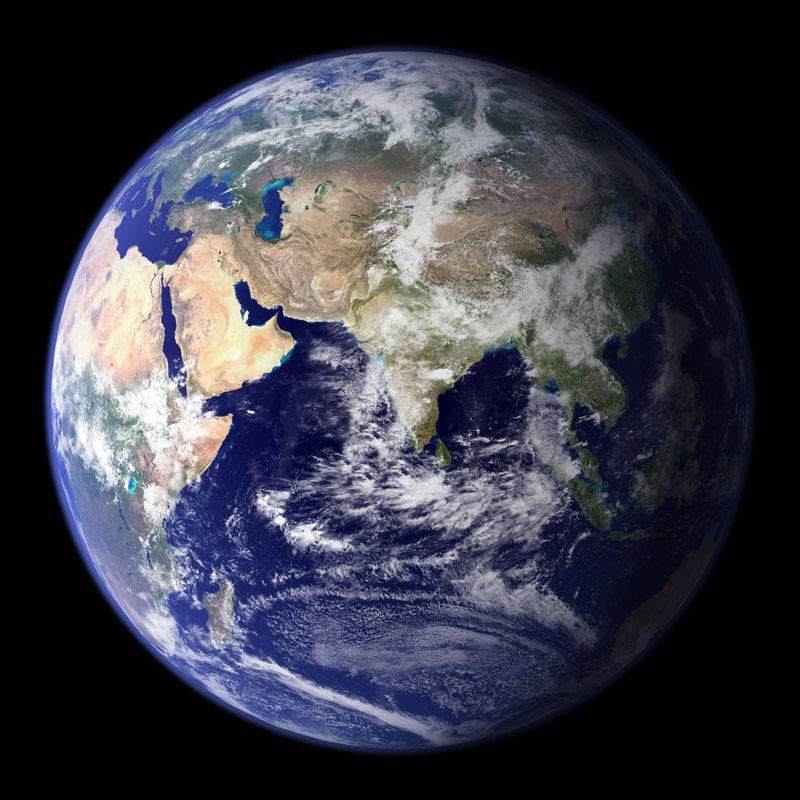
(An example of the five major oceans and the World Ocean. SOURCE)

71% of Earth is covered by ocean. The area of the World Ocean--which is the Atlantic, Arctic, Indian, Pacific, and Southern Oceans combined as a single body of salt water--is 361 million square kilometers (139 million square miles), and is approximately 1.3 billion cubic kilometers (310 million cubic miles) in volume. The average depth is 3,790 meters (12,430 feet), and the deepest point is 10,924 meters (6.787 miles), at the Mariana Trench.


99% of Earth's living space is provided by the oceans--it is estimated they provide 300 times the habitable volume of land habitats. 90% of of that living space exists in the deep sea, the area below 200 meters (660 feet). Around 230,00 marine species are currently known, but that number could be up to ten times higher.


Humans have explored less than 10% of the ocean. The Challenger II reached the Mariana Trench in 1951 and named its deepest point Challenger Deep, and the Trieste also reached the Trench in 1960 with a two-man crew, but much of the ocean floor is still unmapped and unknown.

News and information on ongoing and past projects, such as the Indonesia-USA Deep-Sea Exploration and the exploration of the deep reefs of the Indo-Pacific, can be found HERE.


*****

Sources:
http://www.savethesea.org/STS%20ocean_facts.htm
http://www.noaa.gov/ocean.html
http://en.wikipedia.org/wiki/Ocean
http://geology.com/records/deepest-part-of-the-ocean.shtml
http://en.wikipedia.org/wiki/Marine_biology

*****

Have you ever seen the ocean?


-----The Golden Eagle
Enhanced by Zemanta

15 October, 2010

Blog Action Day 2010: Water

Today is October 15th, Blog Action Day. Each year on this date, bloggers come together to blog about one global issue, and this year, it's water.


Water is necessary for life. Earth is the way it is due to water, and all animals, including humans, cannot live without this highly valuable liquid--it could become a scarce resource in the 21st century.


Here are some facts about water and its consequences:


The average American uses 159 gallons of water per day, which is 15 times more than the average person in the developing world.

Around one in eight people do not have access to safe water supplies.


3.575 million people die each year from water-related diseases; a child dies of a disease every 20 seconds.

Only 62% of the world's population has access to adequate sanitation.


In Africa, women and children walk a total of 109 million hours to get water, over 40 billion in a year.

It takes half a liter of water to charge an iPhone--and there are over 80 million of those devices worldwide.

It takes 1,514 liters of water to make a cotton t-shirt.


2.5 billion people do not have access to toilets.

80% of the discharged material in developing countries is untreated, and pollutes water resources.

2 million tons of human waste are deposited in water sources every day.


Petitions by Change.org|Start a Petition »


I live in the USA--compared to a lot of people, I'm extremely fortunate to have running water within reach almost all the time.

Think about water. We wouldn't be here without it.

{Images found online--I do not own/claim anything}

-----The Golden Eagle
Enhanced by Zemanta

30 September, 2010

Flood Watch, Writer Things, and Coffee

I can believe it. It's been raining, raining, raining, pouring, dripping, sopping, and splishing all day long.

I realize that the last word isn't actually a word. Except I'm a writer--I've got creative license, right? Well. I say, very splishingishly, that writer's have the creative license to create new words.

But there is a lot of water. The street's sort of flooded and the gutters on the neighbor's house are pouring water. It's been dark, gloomy, and wet all day, but I'm content. I'm usually in a content mood when it's raining, and also because I've been successful editing-wise.

*****

Have any of you seen THIS POST? Or, THIS POST?

Yes? No?

Well, the second makes me laugh. Actually, the first makes me laugh because seriously, folks? If you're going to date a writer you should expect a whole different can of beans.

I don't actively lock myself up in my room or anything and write like some people do, (do you?) but I do tend to get crabby/irritable/fussy when my writing's not going right. And "writer's will remind you that money doesn't matter so much"? Ahem. A lot of writers go into the business because they're broke. I'll let you decide for yourself whether the other points are true. :D

*****

NaBloWriMo starts tomorrow! Hooray! I'm excited about this. It just seems like it's going to be fun, you know? Well, maybe I'm just overexcited. I already post pretty often . . . maybe it's the fact I won't be alone this time. :)

If you haven't joined yet, my armies are still waiting around for the next victim. (AKA you.)

*ahem*

*****

I never really liked coffee. I am repelled by the scent of coffee, especially really strong stuff; I like the smell of Barnes & Noble (one of my favorite smells) but I don't like just coffee. How do people drink it? HOW?

But apparently people do. At least according to a recent survey done by Careerbuilder and Dunkin Donuts. (I've never been to Dunkin Donuts--or Starbucks, for that matter.)

Huh. Oh, well. I plan on being a scientist; I'll just have to be a non-coffee-drinker one.

*****

End of September everyone! Can you believe it? Another month has disappeared. I think this month has gone rather well for me, since I got some stuff done . . .

What about you?

-----The Golden Eagle